
What Does a Startup Product Development Company Actually Do?
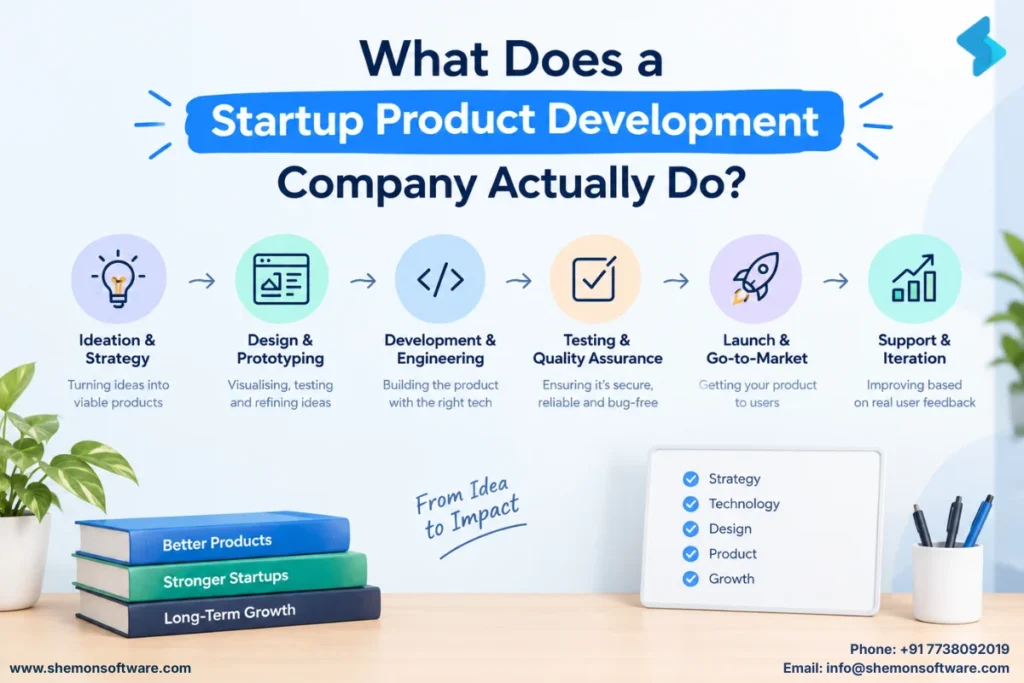
Most startups don’t fail simply because they have a bad idea. Problems can arise when an idea is not properly validated, the product scope is unclear, or development begins before the business understands what users actually need.
That’s where a Startup Product Development Company can help. Instead of focusing only on writing code, a product development partner can bring together product strategy, UX/UI design, engineering, testing, and launch support to turn an early-stage idea into a usable product.
Quick answer: A startup product development company helps founders move from an initial idea to a validated and functional product by combining product strategy, design, development, testing, and ongoing improvement. The goal is to build what is needed to test the product idea without unnecessarily using limited startup resources.
Why This Matters for Early-Stage Founders
Misreading market demand causes roughly 42% of startup failures, and running out of funding causes another 29%. Both are largely product-execution problems, not luck. A structured build process directly reduces both risks by testing assumptions before you spend heavily.

How the Process Works
- Discovery – Define the problem and target user (1–2 weeks).
- Scoping – Decide the minimum feature set that proves value. This is where MVP development for startups matters most: build small, validate fast.
- Design – Wireframe and test with real users before writing code.
- Development – Build using the right stack for your platform and budget.
- QA & Launch – Test thoroughly, then ship with analytics in place.
- Iterate – Use real usage data to guide version two.
What Is Startup Product Development?
Startup product development turns a business idea or identified user problem into a functional digital product.
Depending on the startup’s requirements, the process can include:
- Product discovery and strategy
- Market and user research
- MVP planning
- UX/UI design
- Web or mobile application development
- AI and software development
- Quality assurance and testing
- Product launch
- Analytics and performance tracking
- Post-launch improvements
A startup product development company can bring these capabilities together so founders do not have to coordinate separate teams for strategy, design, development, and testing.
Most MVPs take 8-16 weeks to launch, with costs typically ranging from $15,000 to $150,000+ depending on complexity and platform.

What to Look for in a Partner
- Product strategy input, not just code execution
- In-house UX/UI capability
- Transparent, phase-based pricing
- Post-launch support and iteration, not a one-time handoff
- Relevant experience with early-stage products specifically
Founders who don’t need a fully custom build from day one should be cautious: custom software development for startups is valuable when off-the-shelf tools genuinely can’t meet the need, not as a default starting point.
In-House vs. Freelancers vs. a Development Company
| Factor | In-House | Freelancers | Development Company |
|---|---|---|---|
| Speed to start | Slow | Fast | Fast |
| Cost predictability | Low | Medium | High |
| Product strategy input | Depends | Rare | Usually included |
| Best for | Long-term, funded teams | Small isolated tasks | Full early-stage builds |
For startups that need broader technology solutions, not just an app, but the infrastructure and tooling around it, a development company typically offers more continuity than piecing together freelancers project by project.
FAQs
Typically $15,000-$150,000+, depending on features, platform, and team location.
Most take 8-16 weeks; simple builds can launch in 4-6 weeks.
No, these companies exist specifically to fill that gap for non-technical founders.
Check for product strategy involvement, transparent pricing, relevant portfolio work, and post-launch support, not just development speed.
Look for product strategy involvement, relevant startup experience, transparent pricing, UX/UI capabilities, development expertise, practical communication, and post-launch support.
For many early-stage startups, starting with an MVP can help validate the core product idea before investing in a larger product. The right approach depends on the product, market, users, funding, and business requirements.
Startup Product Development with Shemon
Building a startup product requires more than development alone. Founders often need to make decisions about product scope, user experience, technology, MVP priorities, and future scalability at the same time.
Shemon brings product strategy, AI engineering, UX/UI design, and software development together to help startups move from an initial idea toward a functional product.
The team can support different stages of the product journey, from defining the initial scope and designing the experience to developing, testing, launching, and improving the product.
Instead of coordinating separate freelancers for strategy, design, and development, startups can work with one team across the product lifecycle
Ready to Scope Your First Build?
If you’re deciding how to approach your first build, a short conversation about your specific constraints, budget, timeline, and the core assumption you need to test, can clarify the right starting point before you commit resources.
Shemon partners with founders from idea to scale, combining product strategy, AI engineering, and design under one roof, so you’re not stitching together freelancers or guessing your way through the build. Book a free 15-minute discovery call, and the team will map your workflow, show you what’s possible, and put together a custom proposal.
Tags
Startup Product Development Company
MVP development for startups


