
Healthcare IT Software Development in India: A Practical Guide
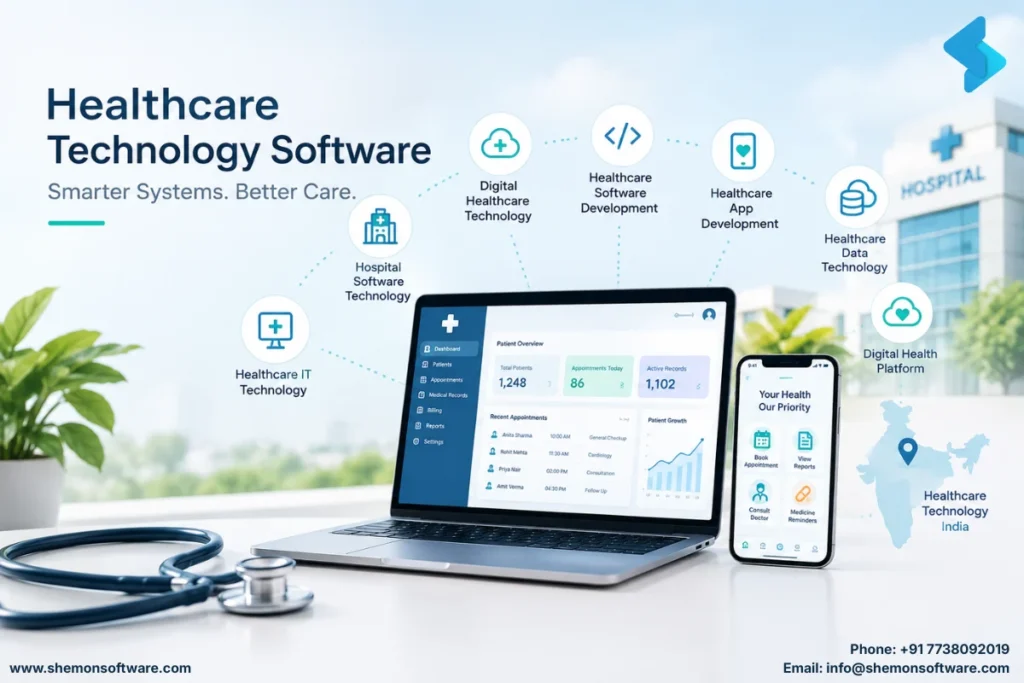
Healthcare IT software development in India involves designing, building, integrating, and maintaining digital systems for hospitals, clinics, insurers, and healthtech companies. These solutions can range from a simple appointment app to a hospital-wide platform that connects doctors, labs, pharmacies, billing teams, and patients.
As healthcare organisations continue to adopt digital technologies, software needs to do more than simply function. It must support clinical workflows, protect sensitive patient information, integrate with existing systems, and provide a reliable experience for healthcare professionals and patients
Why Are Global Buyers Choosing India?
Several factors have contributed to the growth of healthcare software development in India.
- Technical talent: Indian engineering teams work across cloud computing, mobile development, artificial intelligence, data engineering, and cybersecurity, which are important capabilities for modern healthcare products.
- Large and diverse healthcare ecosystem: India’s healthcare sector includes hospitals, clinics, diagnostic centres, pharmacies, insurers, and healthtech businesses. This creates experience across different healthcare workflows and digital requirements.
- Digital health initiatives: Programs such as the Ayushman Bharat Digital Mission are contributing to India’s broader digital health ecosystem and increasing the focus on interoperability and connected healthcare systems.
- Cost efficiency: Businesses can access specialised software development talent at competitive costs, allowing them to allocate resources toward development, testing, security, usability, and ongoing support.
- Overlapping work hours: Development teams working with international clients can structure schedules to provide communication and support across regions such as the US, UK, Europe, and the Middle East.
What Does Building a Health Product Involve?
Healthtech software development goes well beyond writing code. Teams must understand clinical routines, patient privacy, and medical data standards before designing a single screen.
A typical project runs through five stages:
- Workflow mapping: Watching how doctors, nurses, and front-desk staff actually work.
- Compliance planning: Identifying which rules apply, such as HIPAA, GDPR, and India’s digital health guidelines.
- Prototyping: Testing early designs with real users.
- Development and integration: Connecting the product to existing systems through HL7 and FHIR standards.
Validation and launch: Security testing, staff training, and a phased rollout.

What Healthcare Software Solutions Are Most in Demand?
Healthcare organisations use software for many different operational and patient-care requirements. Common healthcare technology solutions include:
- Electronic health records: Searchable and centralised patient information that can help authorised healthcare professionals access relevant records.
- Telemedicine platforms: Digital consultations, appointment scheduling, electronic prescriptions, and patient follow-ups.
- Remote monitoring: Integration with wearable and connected devices to collect relevant health information and make it available to care teams.
- AI clinical support: Applications involving risk assessment, medical image analysis, clinical decision support, and automated documentation, depending on the use case and applicable requirements.
- Billing and claims automation: Software that can automate parts of billing, claims processing, and administrative workflows.
- Hospital management systems: Platforms that connect areas such as appointments, patient records, billing, pharmacy, laboratory operations, and administration.
How Much Does It Cost and How Long Does It Take?
Cost depends on scope, integrations, and compliance needs. A focused prototype or MVP often falls between $20,000 and $50,000, while enterprise platforms can cost many times that. A simple app may take three to four months. A complex hospital system can take nine to eighteen months. Regulatory validation adds time, so plan for it from day one.
How Do You Pick the Right Partner?
Use this checklist before signing anything:
- Proven medical projects: Ask for case studies, not just general software credentials.
- Security credentials: ISO 27001 certification and written data-handling policies are strong signs.
- Interoperability experience: Confirm hands-on work with HL7 and FHIR.
- Clinician involvement: The best teams consult medical professionals during design, not after launch.
- Long-term support: Clinical software needs continuous patches, monitoring, and updates.
What Mistakes Should You Avoid?
- Skipping user research: Tools that ignore clinical routines get abandoned within months.
- Treating security as a final step: Privacy controls must be designed in from the start.
- Underestimating integration: Connecting legacy systems often takes longer than building new features.
- Choosing on price alone: The cheapest quote can turn expensive after compliance failures or rework.
FAQs
Healthcare IT software development is the process of designing, developing, integrating, and maintaining software solutions for hospitals, clinics, healthcare providers, insurers, and healthtech companies. These solutions can include electronic health records, telemedicine platforms, hospital management systems, patient portals, healthcare automation tools, and remote patient monitoring applications.
Healthcare software development companies in India can build a wide range of solutions, including electronic health record (EHR) systems, hospital management software, telemedicine platforms, patient portals, appointment scheduling systems, pharmacy and laboratory management software, remote patient monitoring solutions, healthcare billing platforms, and AI-powered healthcare applications. The right solution depends on the organisation's workflow, users, integration requirements, security needs, and business goals.
Yes, when the partner uses encryption, role-based access, audit trails, and signed data-protection agreements.
Yes. Many have delivered compliant systems for American and European clients.
Usually. A minimum viable product lets you validate the idea with real users before committing to a full build.
Ask how they handle patient data, which standards they have implemented, and who will support the system after launch.
Why Choose Shemon for Healthcare Software Development?
Healthcare software needs a combination of technical expertise, security awareness, integration capabilities, and an understanding of real-world workflows.
Shemon helps businesses build custom software and digital solutions based on their specific requirements. Healthcare projects can involve areas such as custom applications, workflow automation, AI-powered solutions, web and mobile development, integrations, and scalable digital platforms.
The right approach starts with understanding the workflow, protecting sensitive information at every layer, and building software that can integrate and scale as requirements change.
Whether you are planning a healthcare MVP, modernising an existing application, or automating healthcare workflows, choosing the right technology partner can help create a solution that is practical for users and prepared for future growth.
Tags
Healthcare IT software development India
Healthtech software development


