
Why Every Growing Business Needs a Recruitment Management System
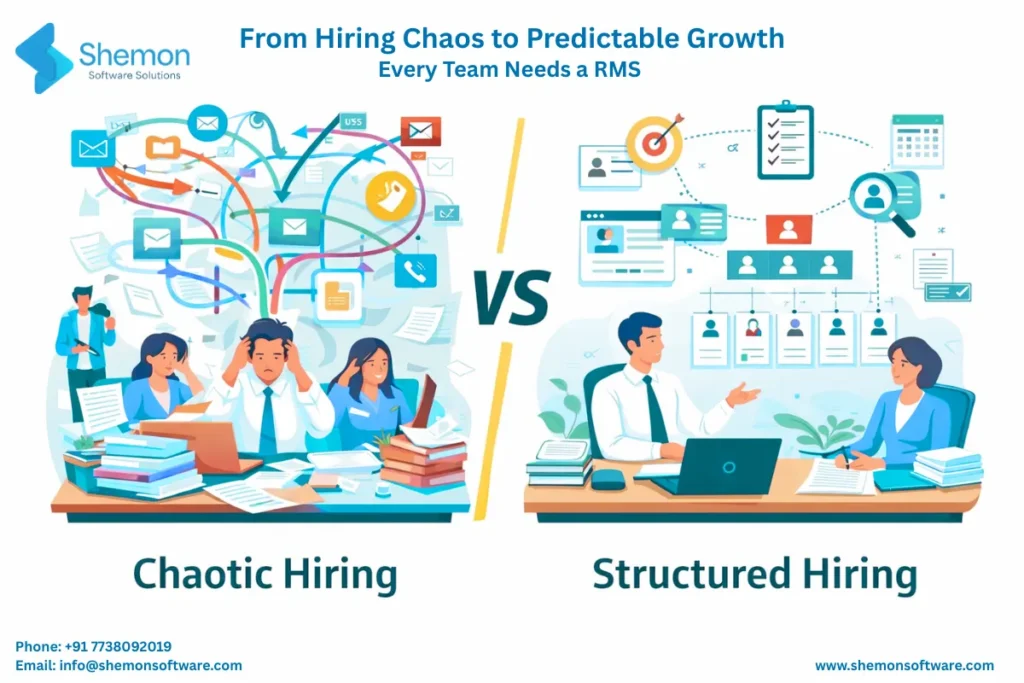
When Hiring Breaks at Scale
Most companies don’t realise how much inefficient hiring is costing them. Here’s what typically happens without a structured recruitment system:
- Recruiters spend 30-40% of their time just searching for information
- Duplicate candidates lead to wasted effort and confusion
- Delayed follow-ups result in losing top candidates
- Managers have no real-time visibility into pipeline health
A response delay of even 24-48 hours can significantly reduce candidate conversion in competitive roles.
This means the problem is not just inefficiency, it’s lost revenue and missed opportunities.
What Is a Recruitment Management System?
A recruitment management system is a centralised platform that helps companies manage their entire hiring process, from sourcing candidates to final placement.
It helps teams:
- Track candidates
- Manage job openings
- Monitor recruiter activity
- Maintain structured data
In simple terms, it replaces scattered processes with one streamlined workflow. Instead of using 5 different tools, everything happens inside one system
How an RMS Works in Real Hiring?
Think of it like this:
- Job Requirement Creation
Hiring managers add roles with clear requirements, timelines, and ownership. - Candidate Sourcing
Recruiters upload or source candidates into a centralised database. - Screening & Shortlisting
Profiles are tagged, filtered, and shortlisted based on fit. - Follow-Ups & Interviews
All follow-ups, feedback, and scheduling happen in one place. - Closure & Reporting
Final candidates are placed, and performance metrics are tracked.
Good RMS software ensures that every step is visible, trackable, and easy to manage.
RMS Features That Actually Make a Difference
Not all tools are useful. The right system focuses on practical features:
- Centralised candidate database – No more digging through emails or folders, everything is searchable.
- Real-time tracking of recruiter activity – Know exactly what each recruiter is working on.
- Automated follow-ups and reminders – Never miss a follow-up or interview update.
- Role-based access and dashboards – See how many candidates are in each stage.
- Reports and performance insights – Understand what’s working and what’s not.
A well-designed recruitment management software removes chaos rather than adding complexity.
Why More Teams Are Adopting RMS?
Companies are moving to structured systems because the impact is clear:
1. Faster Hiring
No more searching through emails or spreadsheets, everything is accessible instantly.
2. Better Visibility
Managers can track recruiter performance and pipeline status in real time.
3. Reduced Errors
Duplicate profiles and missed follow-ups decrease significantly. One system = no repeated sourcing.
4. Stronger Team Collaboration
Teams work on the same platform instead of scattered tools.
5. Data-Driven Decisions
With proper reports, hiring becomes more strategic.
This is why RMS in HR is becoming a standard rather than an option for growing teams.
ATS vs RMS: The Confusion Explained Clearly
One of the biggest misconceptions in recruitment tech is confusing ATS with RMS.
Here’s a practical breakdown:
| ASPECT | ATS | RMS |
|---|---|---|
| Core Function |
Tracks applications and manages basic hiring stages |
Manages the entire recruitment process end-to-end with full visibility |
| Best for | Internal HR teams/Corporate Hiring |
Agencies or teams handling multiple roles, clients, and recruiters |
| Workflow | Follows a fixed, step-by-step hiring flow |
Supports flexible, multi-layered workflows across roles and teams |
| Visibility | Limited to candidate status and progress |
Real-time insights into pipelines, recruiter activity, and performance |
| Customisation | Pre-defined workflows with limited flexibility | Fully customizable to match your exact recruitment process |
Before vs After: The Real Impact of an RMS
Before RMS :
- Recruiters juggling 4-5 tools
- No clear pipeline visibility
- Candidates getting lost
- Managers relying on manual updates
After RMS :
- One dashboard for everything
- Clear hiring stages
- Faster follow-ups
- Measurable recruiter performance
Results:
- Higher placement rates
- Reduced hiring time
- Better client satisfaction
Why Shemon’s RMS?
Shemon doesn’t just give you software; it gives you a structured recruitment system.
- Built around your workflow, not fixed templates
- Solves real issues like scattered data and missed follow-ups
- Gives complete visibility across roles, recruiters, and pipelines
- Simple to use, so teams actually adopt it
- Scales easily as your hiring grows
In short: Less chaos, more control, better hiring outcomes.
Recruitment doesn’t scale with effort; it scales with systems. Without structure, teams stay reactive. With the right system, hiring becomes predictable, measurable, and efficient. A recruitment management system RMS is no longer optional; it’s the foundation for building a scalable recruitment engine.
FAQs
Yes. Even a 3-5 member team can benefit from structure and visibility.
Typically, a few days to a couple of weeks, depending on customisation.
In most cases, yes, it consolidates multiple tools into one.
Significantly. Less manual work = more focus on hiring.
Minimal. Most modern systems are designed for ease of use.
Tags
Recruitment management system RMS
RMS in HR


