
AI Chatbot Development Company: Benefits, Features & Use Cases
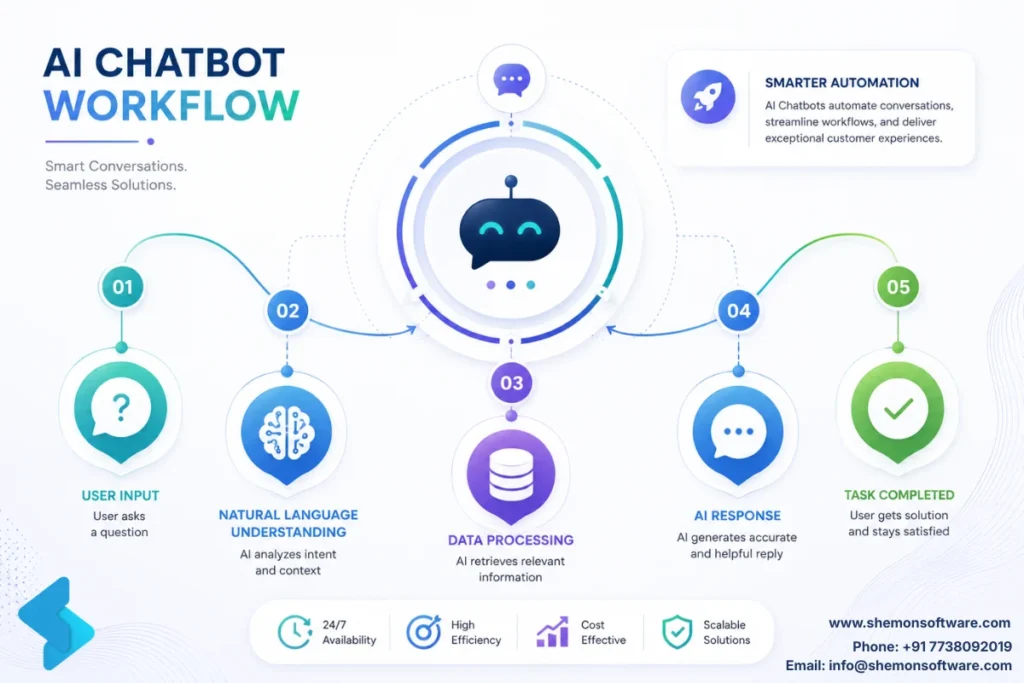
Picture this: a potential customer visits your website at 11 p.m., has a question about pricing, and gets no response. By morning, they may have already purchased from a competitor who answered in seconds. For many businesses, slow response times can mean missed leads, frustrated customers, and lost sales. This is why businesses are turning to an AI Chatbot Development Company to provide instant support and engagement around the clock.
Customer expectations have changed significantly. People want quick, helpful answers instead of ticket numbers and “we’ll get back to you in 24 hours.” At the same time, support teams are managing increasing workloads, businesses are looking for ways to control operational costs, and competitors are adopting automation faster than ever. As conversational AI continues to grow, AI chatbots are moving beyond simple FAQ tools to become an important part of customer support, sales, and business operations.
Quick Summary
- The problem: Businesses lose leads and customer trust due to slow response times, limited support hours, and repetitive manual queries.
- What this blog covers: How AI chatbots work, their benefits, key features, real-world use cases, common mistakes, best practices, and future trends.
- Key takeaway: Partnering with an experienced, specialised development partner helps you build an accurate chatbot, on-brand, and integrated with your existing systems, not just a generic FAQ widget.
- Benefit: Faster response times, lower support costs, higher lead conversion, and 24/7 availability across web, app, and messaging channels.
The Problem: Why Businesses Struggle Without AI Chatbots
Most businesses aren’t short on customers; they’re short on time to respond to them. Support teams juggle repetitive questions about order status, pricing, and account issues, leaving less time for complex problems that actually need a human touch.
Meanwhile, website visitors rarely wait around. If a visitor can’t get a quick answer, they bounce, and that lead is gone. Traditional contact forms and static FAQ pages don’t solve this because they aren’t conversational; they require the customer to do all the work of finding an answer.
This is the gap that AI Chatbot Development Services are built to close: instant, accurate, always-on conversations that feel human without needing a human on the other end for every single query.
Understanding AI Chatbot Development
AI Chatbot Development refers to the process of designing, building, training, and deploying software that can understand natural language and hold meaningful conversations with users. Unlike the scripted “press 1 for sales” bots of the past, modern chatbots use natural language processing (NLP), machine learning, and increasingly large language models (LLMs) to understand intent, context, and even tone.
There are generally three types of chatbots businesses build today:
| Chatbot Type | How It Works | Best For |
|---|---|---|
| Rule-based | Follows pre-set decision trees and keywords | Simple FAQs, basic navigation |
| AI/NLP-powered | Understands intent and context using machine learning | Customer support, lead qualification |
| Generative AI-powered | Uses LLMs to generate dynamic, human-like responses | Complex queries, personalized conversations, sales assistance |
A Custom AI Chatbot Development approach combines the right type (often a hybrid) with your specific data, workflows, and brand voice, rather than a generic, one-size-fits-all bot.
Why AI Chatbots are Important for Modern Businesses
Customer behavior has changed permanently. Recent industry data shows 82% of customers would rather use a chatbot than wait for a human representative, and businesses report roughly $8 in returns for every $1 invested in chatbot technology, according to multiple 2026 industry reports. That kind of ROI is hard to ignore, especially when support costs keep climbing.
There’s also a shift in search behaviour underway. AI-powered search experiences (like AI Overviews) are changing how people find information online, which means businesses need conversational touchpoints, not just static web pages, to stay discoverable and useful.
For businesses specifically evaluating outsourced or offshore development, this matters even more. India’s chatbot market alone is projected to grow from roughly $293–316 million in 2024–2025 to over $1.2 billion by 2030, at a CAGR above 25%, reflecting the rapid acceleration of adoption in this market.
Key Benefits of Working with an AI Chatbot Development Company
Partnering with a specialized Chatbot Development Company rather than building in-house or using an off-the-shelf tool comes with real advantages:
- Faster time-to-market – experienced teams already have reusable frameworks, NLP pipelines, and integration playbooks.
- Lower total cost of ownership – avoid the cost of hiring, training, and retaining an in-house AI team.
- Better accuracy – proper training data curation and testing reduce hallucinations and irrelevant answers.
- Seamless integrations – connecting the bot to your CRM, helpdesk, payment gateway, or inventory system.
- Scalability – a chatbot built to handle 100 conversations can be architected to handle 100,000 without a redesign.
Compliance and security – proper data handling, especially important in regulated industries like healthcare and finance.

Key Features of a Well-Built AI Chatbot
- Natural language understanding (NLU): Recognizes intent even with typos, slang, or incomplete sentences.
- Multilingual support: Especially valuable for businesses serving diverse regional audiences.
- Omnichannel deployment: Works consistently across websites, WhatsApp, Facebook Messenger, and mobile apps.
- Human handoff: Seamlessly transfers complex conversations to a live agent when needed.
- Analytics dashboard: Tracks conversation volume, resolution rate, and drop-off points.
- Personalization: Uses customer history and context to tailor responses.
- Security and data privacy controls: Encrypts sensitive data and complies with relevant regulations (GDPR, HIPAA, etc., where applicable).
Real-World Applications and Industry Use Cases
- E-Commerce
A mid-sized online retailer implemented a chatbot to handle order tracking, size recommendations, and abandoned-cart recovery, reducing repetitive support tickets and improving checkout completion.
- Healthcare
Clinics and healthcare platforms use chatbots for appointment scheduling, symptom pre-screening, and medication reminders, reducing front-desk load while improving patient response times.
- Banking and Financial Services
Banks deploy chatbots for balance inquiries, fraud alerts, and loan pre-qualification, cutting call-center volume while maintaining 24/7 availability.
- Real Estate
Property platforms use chatbots to qualify leads by asking about budget, location, and timeline before connecting them to an agent, saving sales teams hours of manual screening.
- SaaS and B2B
SaaS companies use chatbots for onboarding walkthroughs, in-app support, and demo scheduling, reducing churn during the critical first-week user experience.
Common Mistakes Businesses Make
- Launching without clear use cases – building a bot that tries to do everything usually does nothing well.
- Ignoring conversation design – a technically functional bot with poor dialogue flow frustrates users.
- No human handoff option – trapping frustrated users in a bot loop damages trust.
- Skipping post-launch monitoring – chatbots need ongoing tuning based on real conversations, not a “set it and forget it” mindset.
- Choosing a generic template over custom development – off-the-shelf bots often can’t reflect brand voice or handle business-specific queries accurately.
- Underestimating data quality – a chatbot is only as good as the data and documentation it’s trained on.
Best Practices for Successful Chatbot Implementation
- Start with 3–5 high-impact use cases instead of trying to automate everything at once.
- Design clear fallback and escalation paths to human agents.
- Test extensively with real customer language, not just clean sample questions.
- Keep the bot’s tone consistent with your brand voice.
- Review conversation logs monthly to identify gaps and improve accuracy.
- Choose a partner offering AI Chatbot Development Services in India or similar established markets if you want a strong balance of technical expertise and cost efficiency.
Future Trends in AI Chatbot Development
- Voice-first chatbots: Voice-based conversational AI is growing nearly twice as fast as text-based chat, driven by hands-free and IVR-replacement use cases.
- Agentic AI: Chatbots are evolving from answering questions to completing multi-step tasks autonomously, like booking appointments or processing refunds end-to-end.
- Hyper-personalization: Bots increasingly use behavioral and purchase history data to tailor conversations in real time.
- Multilingual and regional-language support: Particularly relevant in markets like India, where over 300 AI-based language models have been developed to support non-English conversational experiences.
Deeper CRM and ERP integration: Chatbots are becoming a front-end layer for entire business systems, not standalone tools.

FAQs
Costs vary widely based on complexity - a basic FAQ bot may cost a few thousand dollars, while a fully custom chatbot integrated with multiple systems can run significantly higher. Most companies offering Custom Chatbot Development Company services provide tiered pricing based on scope.
Simple bots can launch in 2–4 weeks, while complex, multi-integration chatbots typically take 2–4 months, including testing and optimization.
No - chatbots are best used to handle repetitive, high-volume queries, freeing your team to focus on complex or sensitive issues that need a human touch.
Unless you already have in-house NLP and AI engineering expertise, hiring a specialized company is usually faster, more cost-effective, and lower-risk.
Yes, when built correctly - reputable developers implement encryption, access controls, and compliance measures appropriate to your industry (e.g., HIPAA for healthcare, PCI-DSS for payments).
An AI chatbot development company designs, develops, integrates, and maintains AI-powered chatbots for businesses. Depending on the requirement, the company may build chatbots for customer support, lead generation, sales, appointment booking, internal assistance, or other business workflows. It can also integrate the chatbot with platforms such as websites, WhatsApp, CRM systems, databases, and other business applications.
A traditional chatbot usually follows predefined rules, menus, or decision trees to respond to specific questions. An AI chatbot uses technologies such as natural language processing and large language models to understand user intent, context, and variations in language. This allows it to handle more open-ended conversations and provide more flexible, personalized responses.
Ready to Explore What a Chatbot Could Do for Your Business?
AI chatbots have moved well past the era of clunky, scripted bots. Today, they’re a core part of how businesses respond to customers instantly, reduce operational costs, and stay competitive in a search landscape increasingly shaped by AI. The businesses winning in 2026 aren’t the ones with the fanciest chatbot; they’re the ones that clearly defined their use cases, invested in proper conversation design, and partnered with a team that understands both the technology and their industry.
If you’re evaluating your options, start small: identify your top three customer pain points, and look for a development partner with proven experience solving similar problems in your industry, not just a portfolio of generic demos.
If you’re weighing whether a chatbot makes sense for your business, start by mapping your most repetitive customer queries; that’s usually where the clearest ROI lives. Feel free to reach out if you’d like a second opinion on your use case before committing to a build.
Tags
AI Chatbot Development Services in India
AI Chatbot Development Company


