
Hospital Management Software Development: Features, Benefits & Process
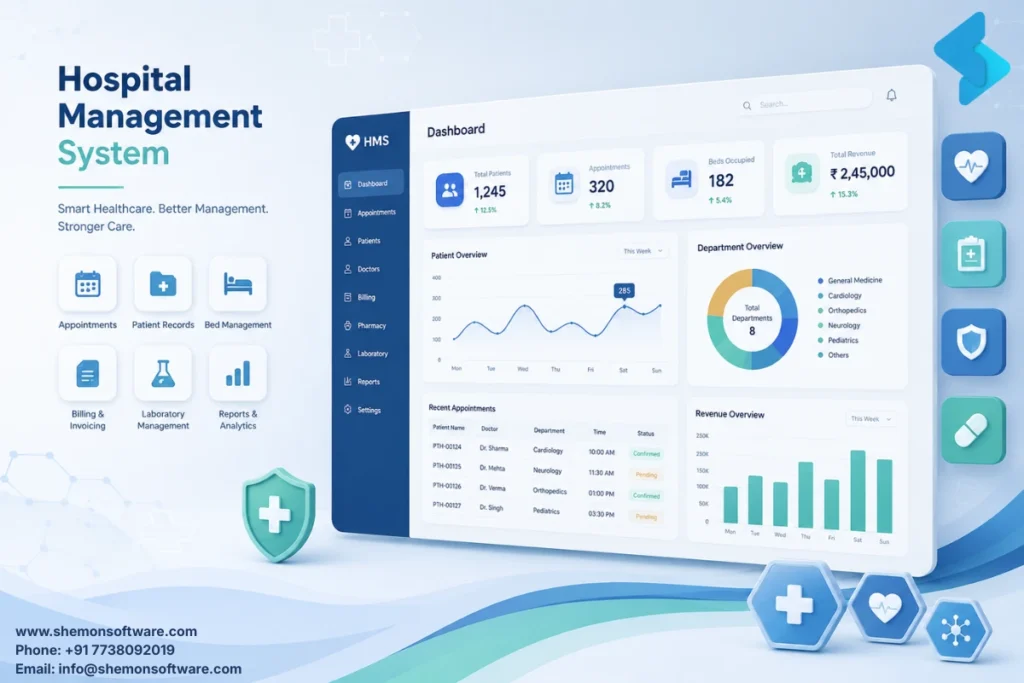
It’s 2 a.m. A nurse is trying to find out if a patient is allergic to penicillin before the next dose is given. The allergy note is somewhere, maybe in the paper chart from admission, maybe in a system the day shift used, maybe nowhere at all. She has to call around and hope someone picks up.
Situations like this highlight one of the biggest challenges hospitals face: keeping critical information accessible when and where it’s needed. That’s exactly the gap that Hospital Management Software Development is designed to address not with flashy features, but by making sure the right information is available to the right people at the right time.
Hospitals rely on information moving quickly between dozens of people, including doctors, nurses, pharmacists, billing staff, and lab technicians. When that information gets stuck in separate systems or manual processes, patients may face longer wait times, staff spend more time on administrative work, and the risk of errors can increase.
Quick Summary
- The real problem: Hospitals still juggle disconnected tools, one for scheduling, another for billing, paper for everything else, and it costs time, money, and sometimes patient safety.
- What you’ll learn: How hospital management software actually gets built, what it should include, where hospitals commonly get it wrong, and where the industry is headed.
- The bottom line: A good hospital management system isn’t about adding more software; it’s about removing the gaps between the software you already depend on.
The Problem Nobody Talks About Enough
Nobody plans to end up with five different systems that don’t talk to each other. It happens one department at a time: someone buys a scheduling tool, someone else picks a billing platform, and inventory just… stays on a spreadsheet because nobody got around to fixing it.
Fast forward a few years, and staff are re-typing the same patient details into three separate screens. A billing error slips through because insurance details live in a totally different place from treatment notes. Nobody’s cutting corners on purpose; the system itself is just working against them.
So, What Is Hospital Management Software Development, Really?
Strip away the jargon, and hospital software development is really just this: building the digital plumbing that lets every part of a hospital talk to every other part, registration, doctors, pharmacy, billing, lab, and beyond- without someone manually shuttling information between them.
It’s not the same as building an app for a retail store. A hospital information management system has to hold up under strict privacy laws (HIPAA in the US, GDPR in Europe), handle life-or-death timing, and stay online basically all the time, because when it goes down, care doesn’t stop; it just gets harder.
In practice, that usually means building out:
- Patient-facing pieces (booking, portals, check-in)
- Clinical pieces (records, lab results, prescriptions)
- Admin pieces (staff schedules, HR, supplies)
- Financial pieces (billing, claims, payroll)
A solid healthcare management system connects all four, so a change in one place- say, a new prescription- automatically shows up everywhere else it’s needed.
Why This Isn't Just an "IT Upgrade"
Here’s the thing: this isn’t a nice-to-have anymore. According to market research from Straits Research, the global hospital management solutions market is on track to grow from around $8.88 billion in 2026 to over $33 billion by 2034, and that growth is being driven by hospitals moving away from manual, patched-together operations toward connected digital ones.
That’s not a trend chasing hype. It’s hospitals responding to real pressure: more patients, tighter staffing, and compliance rules that get stricter every year. You genuinely can’t scale a hospital safely on spreadsheets and sticky notes anymore.
Putting real thought and budget into healthcare software development has quietly become one of the most practical decisions a hospital can make, not because it’s trendy, but because the alternative gets more expensive every year it’s delayed.
What Hospitals Actually Gain From It
Let’s be specific about what actually changes when this is done well.
For patients and clinical staff
- Doctors see the full patient picture instantly, not fragments
- Fewer medication mix-ups because allergy and history data are right there
- Specialists across departments can actually coordinate instead of guessing
For the people running the building
- Scheduling that adjusts itself instead of needing constant babysitting
- A lot less paperwork and manual re-entry
- Real-time answers to “do we have a bed?” or “are we low on supplies?”
For the finance side
- Billing mistakes drop sharply once systems stop duplicating manual entry
- Insurance claims move faster
- Leadership actually has clean data to plan budgets around
| What You're Looking At | Without a Connected System | With One |
|---|---|---|
| Finding a patient's record | Someone goes hunting | It's just there, instantly |
| Billing accuracy | Manual entry, manual mistakes | Checked automatically |
| Staff schedules | Spreadsheets and group chats | Built and adjusted automatically |
| Compliance reporting | Someone pulls it together by hand | Logged automatically |
| Supply tracking | You find out when you run out | You see it coming |
How These Systems Actually Get Built
This isn’t a weekend coding project. It’s closer to building the nervous system of a hospital, one careful step at a time.
Step 1: Actually Talk to the People Who’ll Use It
Before anyone writes code, the team sits down with nurses, doctors, and admin staff to understand how work really happens, not how it’s supposed to happen on paper.
Step 2: Decide How the Data Will Live
This is the unglamorous but critical part: figuring out how patient data, billing, and clinical workflows connect. Get this wrong, and you’re rebuilding the whole thing in three years. Get it right, and you’ve got a hospital information system that can grow with the hospital.
Step 3: Build the Pieces, One at a Time
Registration, records, billing, and pharmacy teams usually build the highest-impact pieces first rather than trying to launch everything at once.
Step 4: Make Sure Everything Actually Talks to Each Other
Lab machines, insurance platforms, pharmacy systems- all of it gets connected and stress-tested so data moves cleanly between them.
Step 5: Lock Down Security, Properly
Given what’s at stake with health data, this stage means real penetration testing and compliance checks against standards like HL7 and FHIR, not a checkbox exercise.
Step 6: Roll It Out and Actually Train People
This is where a lot of good software quietly dies. If staff don’t trust it or understand it, they’ll find workarounds, and the investment doesn’t pay off.
The Pieces That Make Up a Complete System
A well-rounded hospital management software setup usually covers:
- Registration and appointment scheduling
- Electronic Health Records (EHR/EMR)
- Billing and insurance claims
- Pharmacy and inventory tracking
- Lab and radiology systems
- Staff and HR management
- Dashboards that actually mean something to leadership
- Patient portals and telehealth
Bigger hospitals often go a step further with hospital ERP software, stretching the system past clinical work into finance, procurement, and supply chain, so the hospital runs more like one connected organisation instead of a dozen departments each doing their own thing.
What This Looks Like in Real Hospitals
A mid-sized hospital network merged its scheduling, billing, and records into one system. Check-in times dropped noticeably, and duplicate billing errors nearly disappeared once claims were validated automatically instead of by hand.
A chain of diagnostic labs connected its locations through a shared hospital information management system, so a result from one site was instantly visible at another. That alone cut down on repeat tests patients were being asked to redo unnecessarily.
A rural hospital group added telehealth into its existing setup, letting specialists based at a central hospital weigh in on cases from smaller, understaffed clinics, without anyone having to physically travel.
The pattern in all three: the win wasn’t “we bought software.” It was connecting things that used to sit apart.
What the Hospitals That Get This Right Do Differently
- They bring clinicians and front-desk staff into the conversation early, not just IT.
- They treat interoperability standards like HL7 and FHIR as non-negotiable from the start.
- They roll things out in phases instead of flipping one giant switch.
- They build in solid audit trails, because compliance gets checked, not assumed.
- They keep training going well past launch day, not just during onboarding.
- They design for the hospital they’ll be in five years, not just the one they are now.
Where This Is All Heading
- AI is starting to flag risks earlier – spotting patterns in patient data that a busy human might miss on a packed shift.
- Cloud is becoming the default, not the exception, as hospitals move away from maintaining their own servers.
- Telehealth is no longer a bonus feature – patients increasingly expect it as standard.
- Interoperability (FHIR) is turning into table stakes, not a competitive edge.
- Patients want more control themselves – booking, checking results, and messaging providers without picking up a phone.
FAQs
It depends heavily on scope, but a phased build of the core pieces usually takes anywhere from several months to well over a year for larger, multi-site systems.
If your workflows are fairly standard, off-the-shelf can work well. If they're complex or unique to your facility, custom development tends to pay off over time.
Yes, and it should, but that needs to be planned for from the start, not added on afterwards.
Not quite. An EHR is just the clinical records piece. A full hospital management system includes that plus billing, scheduling, HR, and inventory.
It varies a lot, smaller clinic tools might run into the tens of thousands, while larger, custom, multi-facility systems cost significantly more. Scope is really what drives the number.
None of this is really about technology for its own sake. It’s about a nurse not having to make five phone calls at 2 a.m. to find an allergy note. It’s about a billing team not spending their week chasing down mismatched numbers. It’s about a hospital being able to grow without everything quietly falling apart behind the scenes.
A solid hospital management system doesn’t add complexity; it removes it by connecting the pieces that were never meant to work in isolation in the first place. Whether you go custom or off-the-shelf, the fundamentals stay the same: understand how your staff actually work before you build anything, take compliance seriously from day one, and don’t skimp on training.
Get those right, and you’re not just running a smoother hospital; you’re giving your staff room to focus on what actually matters: the patient in front of them.
Tags
Healthcare Software Development Company
Healthcare IT Services


