
How to Choose the Right Custom Application Development Company
There’s a moment almost every growing business hits: the software that used to work just fine suddenly doesn’t. Your sales team is bouncing between three tools that don’t talk to each other. Someone on ops still keeps “the real numbers” in a spreadsheet because the CRM never quite captures what they need. And every time IT patches one workaround, two more pop up somewhere else.
If that sounds a little too familiar, you’re in good company. It’s one of the most common growing pains out there, and it’s usually the point where people start Googling Custom Application Development Company instead of trying to force yet another off-the-shelf tool to do a job it was never built for. The idea is simple, even if the execution isn’t: build the software around how your team actually works, instead of bending your team around the software.
This guide walks through what that actually looks like. What custom development involves, why it matters, how the process unfolds, what to watch out for, and how to tell if it’s the right move for your business right now (or if it can wait).
Quick Summary
- The problem: Generic software works great until your workflows get specific, then it starts costing you more in workarounds than it saves.
- What’s covered: What custom application development actually is, how the process works, real benefits, common mistakes, and where the industry is heading.
- Key takeaway: The right custom build removes bottlenecks, tightens up your data, and gives you something competitors on the same SaaS tools simply don’t have.
- Who it’s for: Founders, IT leads, and ops managers trying to decide between building custom software or living with another year of patched-together tools.
The Problem With Generic Software
Nobody starts out wanting custom software. Off-the-shelf tools are cheap, fast to set up, and honestly, they’re a perfectly reasonable place to start. Nobody’s saying otherwise.
The trouble shows up later, once your processes get specific enough that the generic tool starts fighting you instead of helping. Rigid workflows that don’t match how you operate. Integrations that almost work. Features you’re paying for every month and have literally never opened.
So teams do what teams do: they build workarounds. An extra spreadsheet here, some manual copy-pasting there, a Zapier chain held together with hope. It’s fine for a while. Then one day someone adds up how many hours a week get burned on this stuff, and the math stops being fine.
That’s usually the point where businesses start looking into application development services, not because custom is trendy, but because the workaround pile has finally gotten more expensive than building something proper.
What Is Custom Application Development?
Put simply, custom software application development means building software for one specific organisation- your workflows, your data, your rules- instead of buying a product that was designed to serve thousands of different companies at once and therefore fits none of them perfectly.
Instead of squeezing your business into someone else’s software, the software gets built around your business: your approval chains, your reporting quirks, whatever weird exception process finance insists on keeping.
That can look like a few different things in practice:
- Internal tools that take over the repetitive stuff nobody wants to do manually
- Customer-facing applications, portals, booking systems, apps your customers actually touch
- Integration platforms that get your CRM, ERP, and accounting software finally talking to each other
- Industry-specific platforms built around whatever compliance or workflow quirks are unique to your sector
Who Actually Needs This
Not everyone. But businesses tend to reach for custom app development once they’ve outgrown what generic tools offer, once they’re in a niche industry with compliance needs nobody else seems to build for, or once they want a system that’s genuinely theirs- something a competitor can’t just buy the same subscription to.
Why Custom Software Matters for Growing Businesses
Here’s the thing about scale: small inefficiencies don’t stay small. Ten wasted minutes per employee per day is barely worth mentioning with a team of five. With two hundred people, it’s a real problem, and it compounds quietly until someone finally notices.
Custom software matters because it’s designed around actual outcomes rather than generic assumptions about how a business “should” work. It reflects how decisions really get made in your company, not how a product manager three states away imagined they might.
There’s also the ownership piece, which people underestimate until they’ve felt the alternative. With custom systems, you own the code, the data structure, the roadmap, all of it. You’re not stuck waiting on some vendor’s quarterly release cycle to get a feature your business actually needs right now.
Key Benefits of Working With a Custom Application Development Company
- Operational Efficiency
The most immediate win is usually the least glamorous: automating the repetitive stuff that generic tools handle badly, or not at all. Free up your people to do the work that actually needs a human. - Scalability
Off-the-shelf platforms tend to have a ceiling. Custom systems don’t – they’re built to add modules, users, and integrations as you grow, without forcing you into a painful, expensive migration two years down the line. - Competitive Differentiation
This is where a custom application development services provider earns its keep by building features that are genuinely yours. A competitor using the same generic SaaS tool as everyone else can’t replicate what was built specifically for your process. - Better Data Security and Control
Generic vendors build for the average customer’s security needs. Custom systems get built around your actual risk profile and compliance requirements, which matters a lot more than it sounds like on paper. - Long-Term Cost Efficiency
Yes, the upfront cost is higher; nobody’s pretending otherwise. But over a few years, custom software tends to avoid the slow bleed of per-seat licensing fees and the productivity lost to workarounds, which adds up faster than most people expect.
How Custom Application Development Works
Knowing what the process actually looks like helps set expectations before you sign anything with an application development company, and honestly, it helps you spot a vendor who’s cutting corners.
- Discovery and Requirements Gathering – Stakeholder interviews, process audits, figuring out what’s actually broken versus what just feels broken.
- Planning and Architecture – Tech stack, scope, timeline, and milestones get locked in before anyone writes a line of code.
- UI/UX Design – Wireframes and prototypes, so you’re reviewing the actual experience before development starts, not after.
- Development – Usually two-to-four-week cycles, with demos along the way so surprises don’t pile up until launch.
- Quality Assurance and Testing – Functional, security, and performance testing, ideally before your users find the bugs for you.
- Deployment – Often staged, so daily operations don’t grind to a halt on launch day.
- Maintenance and Support – The part everyone forgets to budget for, and the part that actually determines whether the software ages well.
Key Features to Look for in a Development Partner
When you’re vetting a custom app development company, the portfolio only tells you so much. These are the things worth actually checking:
| What to Check | Why It Matters |
|---|---|
| Relevant industry experience | Reduces onboarding time and costly misunderstandings |
| Transparent development process | Helps control scope, timelines, and costs |
| Post-launch support | Important for protecting business and customer data |
| Clear communication | Keeps stakeholders aligned throughout development |
| Scalable architecture | Makes it easier to add users, features, and integrations |
Real-World Applications and Use Cases
- Logistics: A regional distribution company ditched three separate spreadsheets in favor of a custom dispatch and tracking application. Manual data entry dropped significantly, and delivery scheduling errors – the kind that make customers angry- became far less common.
- Healthcare: A multi-location clinic group needed a patient intake and scheduling system that actually matched their compliance requirements. Nothing off the shelf came close, so they built one instead.
- Retail: A mid-sized retailer built a custom inventory system that synced in real time across online and in-store channels, finally putting an end to the overselling headaches their old POS software kept causing.
- Financial Services: A lending firm built a custom underwriting tool around its own specific risk model, something no off-the-shelf loan origination platform offered, because that risk model was theirs alone.
Custom vs. Off-the-Shelf Software: A Quick Comparison
| Factor | Custom Software | Off-the-Shelf Software |
|---|---|---|
| Fit to workflow | Built around your exact process | You adapt your process to fit the tool |
| Upfront cost | Higher initial investment | Lower to start |
| Long-term cost | Often cheaper over time, no per-seat fees | Recurring fees that scale with usage |
| Scalability | Grows with the business | Capped by the vendor's roadmap |
| Ownership | You own the code and the data | The vendor holds the keys |
| Time to launch | Takes longer | Available immediately |
| Customization | Basically unlimited, within scope and budget | Whatever the vendor's settings allow |
Future Trends in Custom Application Development
- AI-assisted development is shrinking build timelines through code generation and automated testing.
- Low-code and no-code components are increasingly blended into custom builds, standard pieces move faster, while the core logic stays fully custom.
- API-first architecture is quietly becoming the default, which makes every future integration a lot less painful.
- Cloud-native design keeps winning out for the obvious reasons: scalability and lower infrastructure overhead.
- Security built in from the start, not bolted on later, as data protection rules keep tightening across industries.
Why Businesses Choose Shemon
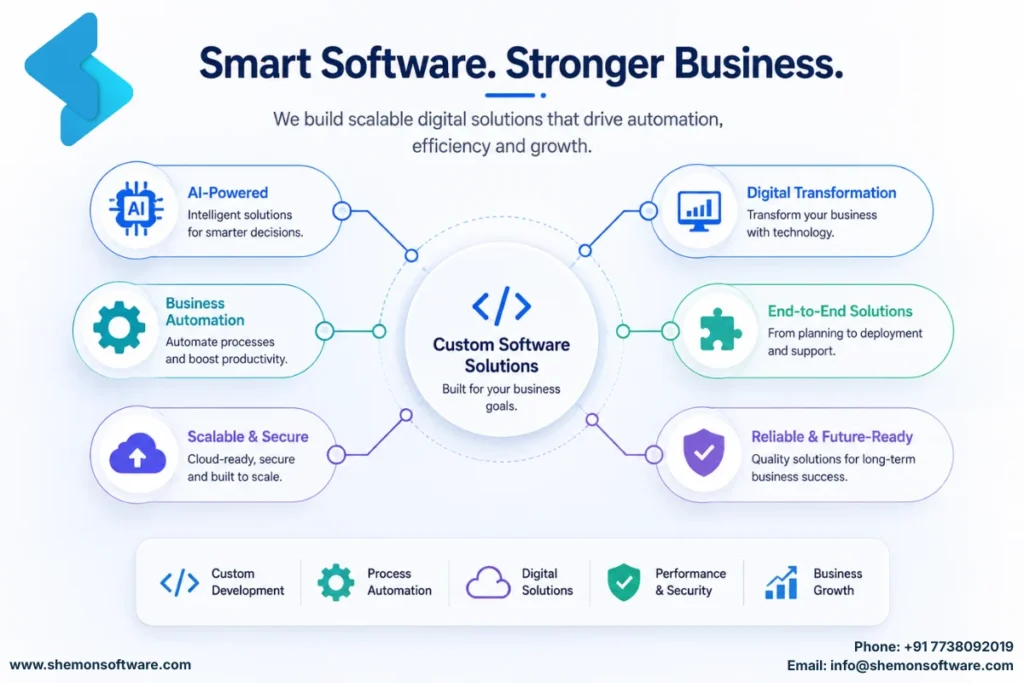
If you’re looking for a custom software development partner, Shemon Software Solutions is built for startups and fast-growing businesses, offering AI-powered applications, SaaS platforms, MVPs, and workflow automation.
What stands out:
- Startup-focused: From MVP validation to scaling, the process is built around founders and product teams.
- Faster development: MVPs typically take around 3–4 months, helping businesses move quickly toward launch or funding milestones.
- AI from day one: AI copilots, intelligent workflows, and automation are integrated into the product, not added as an afterthought.
- Built around your workflow: Shemon understands your processes and bottlenecks before designing the solution.
- Industry experience: Their work includes healthcare, logistics, and recruitment, with HIPAA- and GDPR-compliant platforms.
- Post-launch support: Maintenance and support continue after launch, helping businesses evolve their products over time.
For businesses looking for a long-term technology partner, not just a one-time software vendor, Shemon is worth exploring through a discovery call.
Frequently Asked Questions
Most projects run three to nine months depending on complexity; larger enterprise builds can take longer.
More upfront, typically less over time. You skip the recurring per-seat fees and the slow productivity drain from workarounds that generic tools eventually create.
If your workflows are pretty standard, off-the-shelf might genuinely be enough; no shame in that. Custom makes sense once your process is unique enough that generic tools keep forcing workarounds.
Healthcare, logistics, finance, manufacturing, and retail tend to see the biggest wins, mostly because of compliance needs and operational complexity that off-the-shelf tools weren't built to handle.
Yes, and honestly that's one of the biggest advantages: integrations get designed specifically for your existing CRM, ERP, or whatever else you're running, instead of relying on a generic connector.
Generic software gets you started. It rarely keeps up once your workflows, compliance needs, or customer expectations get specific, and that’s not a knock on the software; it just wasn’t built for you specifically. A good custom software application development company builds around how your business actually runs, which means fewer workarounds, cleaner data, and a system that scales instead of cracking under pressure.
Start with clear requirements. Pick a partner with real, relevant experience. Go in with realistic expectations about both the timeline and what happens after launch. Do that, and custom software stops being just another tool; it becomes something your business actually leans on.
Ready to Explore Custom Software for Your Business?
If you’re on the fence between custom development and sticking with off-the-shelf tools, start by writing down your actual workflow pain points. That alone will make any conversation with a development partner ten times more productive. Feel free to reach out if you’d like a second opinion before you scope anything out.
Tags
Custom Application Development Company
Application development services


