
How Custom ERP Gives Growing Businesses a Competitive Edge in 2026
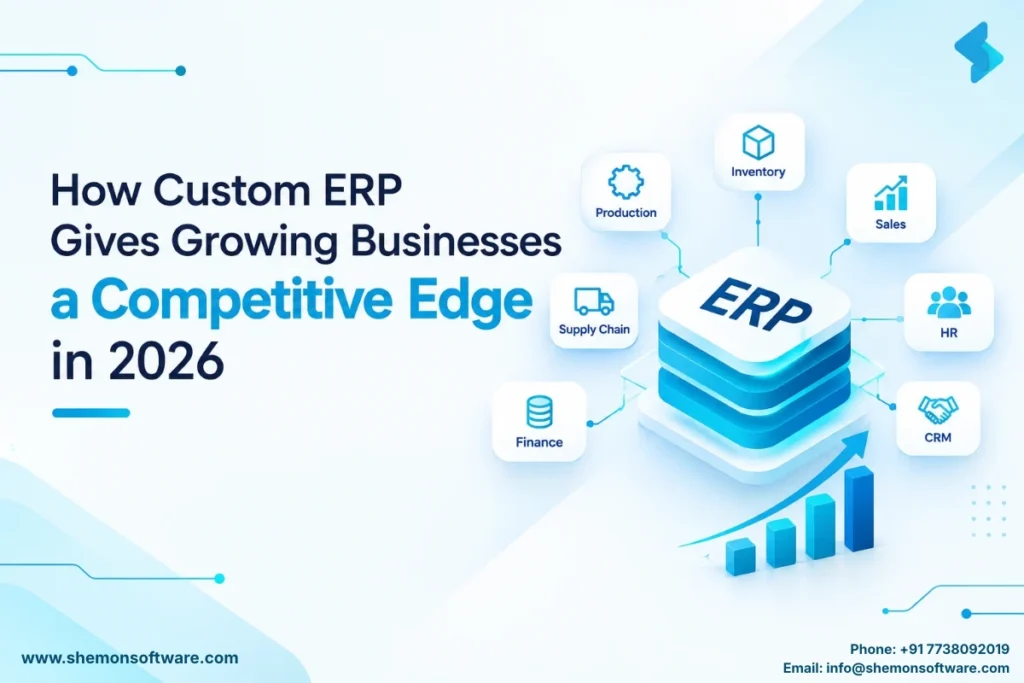
Summary: Off-the-shelf software requires your business to adapt to it. A custom ERP is built around your processes. This guide covers the warning signs, the benefits, current trends, and how to choose the right development partner.
When Disconnected Tools Start Costing You Growth
As businesses scale, disconnected tools become a serious constraint. Sales cannot see inventory, finance reconciles data manually, and leadership waits days for reports. Working with a custom ERP software development company lets you replace this fragmentation with one system designed around how your teams actually operate, instead of forcing your processes to fit generic software.
Signs Your Current System Is Holding You Back
- Manual workarounds are common. Teams rely on side spreadsheets to compensate for system gaps.
- You pay for unused features while critical capabilities cost extra.
- Reporting is slow because data is spread across multiple platforms.
- Scaling is difficult. Each new branch, product line, or compliance requirement demands another patch.
- Vendor priorities differ from yours. Features you need are not on their roadmap.
If two or more apply, a tailored solution deserves serious consideration.
What a Custom ERP Delivers
Unified data. Finance, HR, procurement, production, and sales work from the same live information.
Process alignment. Approval chains, pricing rules, and inventory logic reflect your operations exactly.
Cost control. You pay only for the modules you need, with no shelfware.
Scalability. New warehouses, regions, or business units can be added without replacing the platform.
Clean integrations. Payment gateways, GST tools, logistics partners, and CRM systems connect through purpose-built APIs.
ERP Trends Shaping 2026
- AI-assisted decisions. Demand forecasting, anomaly detection in invoices, and automated reorder suggestions are moving into daily use.
- Modular architecture. Businesses increasingly start with core modules such as finance and inventory, then add HR or analytics as needs grow.
- Mobile access. Approvals and data entry now happen on the floor and in the field, often offline.
- Real-time dashboards. Leaders expect live visibility into margins, cash flow, and stock levels.
Delivering these capabilities requires strong enterprise application development expertise, because early architecture decisions determine whether a system scales smoothly or becomes a maintenance burden.
Why India Is a Strong Choice for ERP Development
India offers advantages beyond cost:
- Engineers with deep experience in manufacturing, retail, healthcare, logistics, and BFSI.
- Practical knowledge of GST, e-invoicing, and multi-state compliance.
- Time-zone overlap with Europe, the Middle East, and Asia-Pacific.
- Mature agile delivery practices and strong English-language communication.
Businesses seeking ERP software development services India benefit from a balance of speed, quality, and value. Providers of custom business software development India also understand the realities of mid-sized companies: controlled budgets, evolving requirements, and the need to demonstrate ROI quickly.
What Does a Custom ERP Cost?
It depends on your business, but a few things determine the price:
- Number of modules (finance, inventory, HR, procurement)
- Number of users and locations
- Integrations with GST tools, payment gateways and accounting software
- Level of customisation
ERP projects in India typically cost around ₹60,000 to ₹20 lakh for small and mid-sized businesses, while large businesses can pay ₹25 lakh to ₹1 crore. A fully custom build usually depends on scope, so a discovery call is the best way to get an accurate estimate.
How to Evaluate a Development Partner
- Relevant case studies. Look for similar industry experience or complexity.
- Discovery before quotation. Strong partners study your workflows before pricing.
- Code ownership. Confirm in writing that you own the source code.
- Post-launch support. Training, maintenance, and updates should be clearly defined.
- Security. Role-based access, audit trails, and encryption should be standard.
A provider of ERP system development services India should be able to answer each of these clearly and with evidence.
A Practical 90-Day Roadmap
Days 1-15: Discovery. Stakeholder workshops, process mapping, and prioritisation of pain points.
Days 16-30: Blueprint. Architecture, wireframes, integration planning, and phased scope.
Days 31-70: Development. Iterative builds with sprint reviews every two weeks.
Days 71-90: Pilot and training. Launch with one department, gather feedback, refine, and expand.
Begin with a minimum viable ERP addressing your largest bottleneck, such as inventory, billing, or procurement, and extend from there.
Common Mistakes to Avoid
- Digitising inefficient processes. Simplify workflows first.
- Under-investing in training. Adoption determines success.
- Selecting on price alone. The lowest bid often leads to costly rework.
Why Choose Shemon Software Solutions
Based in Mumbai, Shemon Software builds custom software and AI-powered workflow automation for growing B2B businesses. Key strengths include:
- SOP-led approach. Solutions are designed around your existing roles, approvals, and reporting, so the system fits your process rather than forcing change.
- Operations-focused experience. For Apvision, Shemon built a custom order management platform with QuickBooks synchronisation and real-time operational visibility.
- Compliance-ready engineering. With seven years of healthcare domain experience, the team has delivered platforms meeting HIPAA and GDPR requirements.
- Agile delivery. Short development cycles take products from MVP to V1 in three to four months.
- Modern technology stack: JavaScript, React, Django, .NET, PostgreSQL, and Flutter, along with AI and WhatsApp automation capabilities.
- Post-launch support. Ongoing support is included for three to twelve months, depending on the package.
A 15-minute discovery call is a practical first step to map your workflows before committing.
FAQs
Ready-made software often has features you don’t need and misses the ones you do. A custom ERP gives you only what your business needs.
A first working version usually takes about 3 months. You can start with one problem area, like inventory or billing, and add more later.
It depends on the features and number of users. Start small and ask for a written, itemised quote before you commit.
Yes. It can link with accounting software, payment gateways, GST tools and your CRM.
You should. Always confirm in writing that you own the source code before signing.
Conclusion
A well-built ERP is a long-term business asset. It improves decision speed, reduces errors, and frees teams to focus on growth. When shortlisting vendors, choose an experienced ERP application development company India with a proven delivery record and transparent communication.
Ready to streamline your operations? Schedule a discovery call with Shemon Software to discuss your requirements.
Tags
Healthcare Software Development Company
Healthcare IT Services


