
Custom CRM Software Development: Why Off-the-Shelf Tools Are Costing You Deals
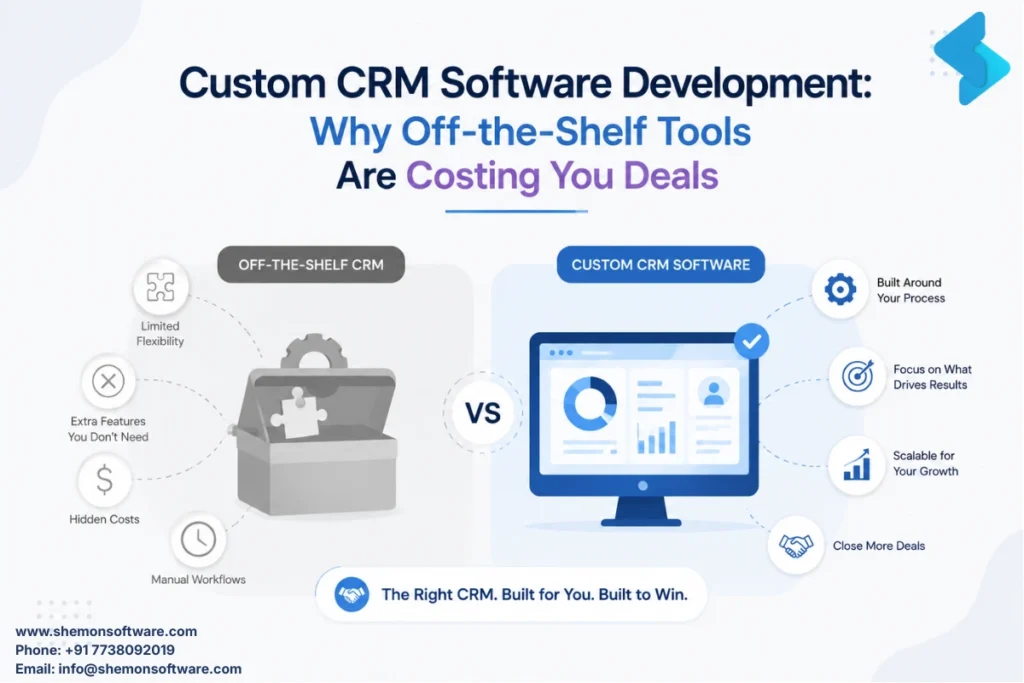
Your CRM should make it easier to manage leads, customers, sales, and business relationships not force your team to work around software limitations. When a ready-made CRM doesn’t match your processes, teams often end up relying on spreadsheets, manual workarounds, multiple integrations, and disconnected systems.
Custom CRM Software Development involves building customer relationship management software around your business’s specific workflows, sales process, customer data, and operational requirements. Instead of adapting your business to a generic platform, you can create a CRM that works around the way your team actually operates.
With a custom CRM, businesses have greater control over features, integrations, automation, data, and future scalability.
Why Businesses Choose a Custom CRM
Standard CRM software applications are designed to serve an “average” organisation, so there’s usually a good chance of purchasing unnecessary features and lacking those that could be useful.
Some key advantages of custom-built CRM include:
- Automation specific to your sales or support process workflow
- Integration capabilities with any third-party application such as ERP, email marketing, and accounting software solutions
- Scalability allowing the platform to develop along with the organisation without needing any expensive migration in the future
- Control over data since the system will be developed and deployed according to your terms
In most cases, companies cooperate with a CRM software development company and control the process of building the platform from scratch themselves.
Why Off-the-Shelf CRMs Often Fall Short
Most ready-made CRM platforms are built to serve as many businesses as possible, which means they’re designed around the “average” company. The problem is, no business is actually average. A real estate agency doesn’t sell the same way a SaaS company does, and a manufacturing firm doesn’t track leads the way a healthcare provider does.
- Because of this, businesses using generic CRMs often run into the same issues:
- Paying for a long list of features they’ll never touch
- Missing the one or two features that would actually make a difference
- Bending their sales process to fit the software instead of the other way around
- Hitting a wall when they try to connect it with older or industry-specific tools
Over time, these small frictions add up. Sales reps waste time on manual workarounds, data gets duplicated across tools, and reporting becomes unreliable because the CRM was never built to capture the metrics that matter to your business.
For example, if a business receives leads from its website, social media, email campaigns, and third-party platforms, a generic CRM may require several integrations or manual processes to bring all that information together. A custom CRM can be designed to automate this process based on the company’s specific requirements
What a Custom CRM Actually Solves
A custom-built CRM removes the guesswork. Instead of adapting your business to fit the tool, the tool is shaped around how your team already works, or how you want them to work going forward.
Here’s what a tailored CRM typically delivers:
- Workflow-specific CRM automation that matches how your sales or support team actually operates, not a generic template built for a different industry
- Seamless integrations with your existing tools, like ERP systems, email marketing platforms, accounting software, or internal databases
- Scalable architecture that grows with your business, so you’re not forced into a costly migration a few years down the line
- Full data ownership, since the system is built and hosted on your terms rather than locked behind a third-party vendor’s rules and pricing changes
Beyond these core benefits, a custom CRM also gives you control over the user experience itself. Through deep CRM customisation, you can design dashboards that show exactly the numbers your team checks daily, hide the clutter nobody uses, and build permission levels that match how your organisation is actually structured.
Why Choose Shemon for Your CRM Needs
Picking the right partner matters just as much as deciding to go custom in the first place. Here’s what sets Shemon apart:
- Deep discovery process – before writing a single line of code, the team maps out your sales pipeline, customer touchpoints, and the reports your business actually relies on.
- Tailored builds, not templates – every CRM is designed around your real workflows instead of being adapted from a generic starting point
- Smooth, reliable CRM integration – connects effortlessly with the tools you already use, so data flows automatically instead of requiring manual entry
- Transparent, staged development – you review progress at each milestone instead of waiting until the very end to see the product
- Scalable architecture – systems are built to grow with your business, so you won’t need a costly rebuild a few years down the line
- End-to-end support – from the first requirement-gathering call to post-launch maintenance and future updates
Most businesses partner with a CRM software development company to handle the technical build, from database design to the user interface, while staying closely involved in defining requirements and reviewing progress at each stage. Shemon keeps that collaboration simple, so you’re never left guessing where the project stands.
Signs Your Business Might Need a Custom CRM
Not every business needs a custom build right away. But certain signs usually point to it being time to consider one:
- Your team relies on spreadsheets or sticky notes alongside your current CRM to fill in the gaps
- You’re paying for multiple add-ons just to get basic functionality your business actually needs
- Your sales process has unique steps that generic CRMs can’t accurately represent
- Reports take manual effort to compile because the CRM doesn’t track the metrics you care about
- Your business is scaling fast, and your current tool is starting to feel restrictive
If two or more of these sound familiar, it’s usually a good time to start exploring a tailored
FAQs
Upfront costs are usually higher, but you avoid recurring per-user license fees and unused features, which often makes it more cost-effective over the long run.
A basic version can take 6 to 10 weeks, while a fully-featured system with multiple integrations may take 3 to 6 months, depending on complexity. The CRM software development process typically includes discovery, design, integration, testing, and post-launch support.
Since you own the system and its codebase, you can add new features, modules, or integrations anytime without waiting on a vendor's product roadmap.
Depending on business requirements, a custom CRM may include lead management, contact management, sales pipeline management, task automation, customer support, dashboards, reporting, notifications, user permissions, third-party integrations, and other industry-specific functionality.
An off-the-shelf CRM provides predefined features designed for a broad range of businesses. A custom CRM is developed around the specific workflows, requirements, integrations, and processes of an individual organisation.
Time to Move On from Generic, Get a Custom CRM!
A custom-built CRM gives your business the exact tools it needs to manage customers without the bloat of generic software slowing your team down. It’s an investment that pays off through fewer workarounds, better data, and a system that actually grows with you. If you’re ready to explore this path, reach out to a trusted CRM development company to scope out your requirements and see what a tailored solution could look like for your team.
Tags
Custom CRM Software Development
CRM development company


