
How to Select the Right Web and Mobile App Development Company
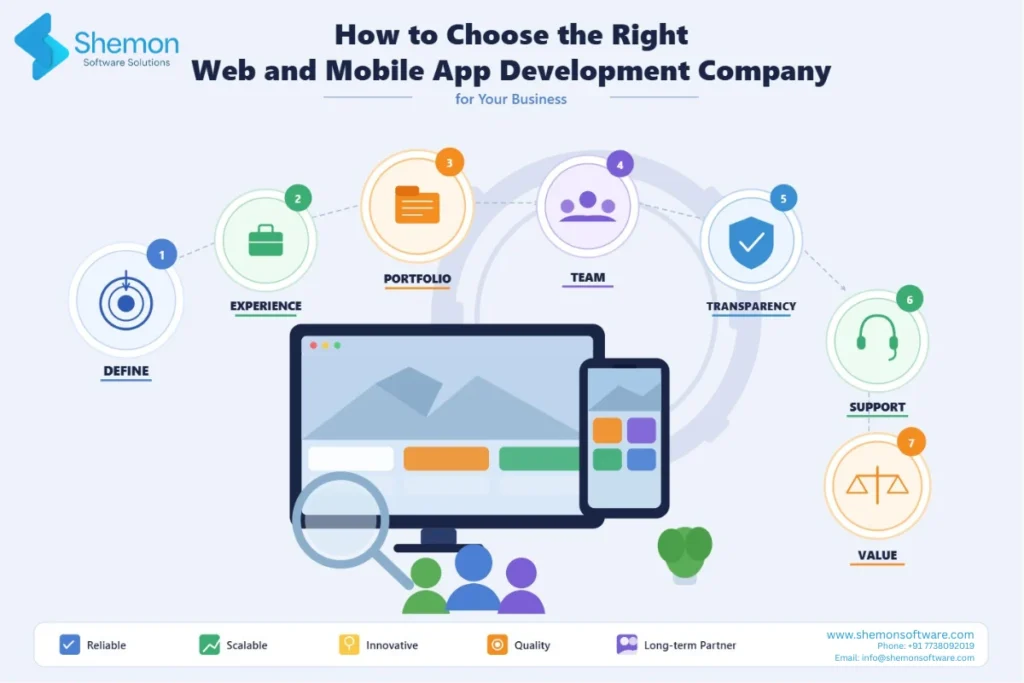
You know what nobody tells you before you hire a web and mobile app development company?
The scariest part isn’t the cost. It isn’t the technology. It isn’t even the timeline.
It’s the moment, six months later, when you realise the app your team built looks nothing like the problem you actually needed to solve. Let’s make sure that never happens to you.
The Number That Should Worry You
66%. That’s the percentage of software and technology projects that end in partial or complete failure. Not because the ideas were bad. Not because the budgets were small. But because the wrong company was chosen, for the wrong reasons, using the wrong checklist.
Most businesses choose a development partner using one of three broken approaches:
- They go with the cheapest quote without asking what’s not included
- They go with whoever was referred without checking if that person’s project was even similar to theirs
- They get dazzled by a beautiful portfolio without verifying if those apps are real, working, live products
None of these approaches protect you. All three have burned businesses that had perfectly good ideas.
Before You Even Start Looking, Know This
Here’s the part most blogs skip.
Choosing a development company starts with being honest about what you actually need. A lot of businesses walk into conversations with a development team with a vague idea and expect the company to figure out the details. That’s like walking into a tailor’s and saying, “Make me something nice”, and then being surprised when the outfit doesn’t fit.
Before you talk to anyone, you should be able to answer:
- What specific problem will this app solve?
- Who will use it daily, your customers, your internal team, or both?
- What does your current workflow look like, and where does it break down?
- What does success look like in 6 months after launch?
You don’t need to know the technology. You don’t need to know the features. But you do need to know the problem. Because the right custom app development company will build their entire approach around your answer to that one question.
The Red Flags Nobody Talks About Loudly Enough
Once you start having conversations with companies, watch for these signals carefully.
- They give you a price before asking questions. A company that quotes you a number before understanding your workflow is guessing. A good team will spend 30 to 60 minutes in a discovery conversation before they even think about a number. If they skip that, they’re selling, not solving.
- They say yes to everything. This feels good in the moment. It should terrify you. Companies that agree with every idea, never push back, never raise a concern, are either inexperienced or too eager to win the business, to be honest. The best partner you can have is one who occasionally says, “That won’t work the way you’re thinking, here’s a better approach.”
- They can’t show you working apps. Screenshots are not proof. Ask to actually download and test apps they’ve built. If they hesitate, or if the apps in their portfolio are concepts that never launched, that’s a serious problem.
- They promise unrealistic timelines. A meaningful app does not get built in two or three weeks. If someone is promising you a complex platform in a month, they’re cutting corners you haven’t discovered yet. Good development, done right, takes time.
- They go silent after launch. Your app going live is not the finish line. It’s the starting line. Operating systems update. Bugs appear under real usage. Features need to evolve. A company that doesn’t talk about post-launch support during the proposal stage is planning to disappear after the final payment.
What to Actually Look For Instead?
Now flip it. Here’s what a genuinely good web application development company looks like in practice.
They start with a discovery phase, a real one, where they map your workflow, ask uncomfortable questions, and document what they understand before a single wireframe gets drawn.
They communicate on a schedule. Weekly updates, progress check-ins, and shared access to project management tools. You should never have to chase them for an update.
They explain their technology choices in plain language. Not because you need to understand the code, but because if they can’t explain why they chose a particular tech stack without using jargon, they probably haven’t thought it through clearly either.
They own their mistakes. Every project hits a bump. How a company handles that bump tells you more about them than their entire portfolio.
They put it all in writing. Scope, timeline, who owns the code, what happens if requirements change, what support looks like after launch. Ambiguity in a contract is expensive.
The Code Ownership Question Nobody Thinks to Ask
Here’s one almost every first-time client misses completely.
Who owns the code after the project ends?
It sounds obvious. You paid for it, so you own it, right? Not always. Some companies retain rights to the codebase, others limit your access to the repository, and some structure things in ways that make you permanently dependent on them for even small changes.
Before you sign anything with a software development company, ask directly: “Will I have full access to the source code, design files, and all project assets from day one?” If they hesitate or add conditions, that’s a conversation worth having before, not after, the contract is signed.
What Shemon Does Differently?
At Shemon, we’ve worked across healthcare, recruitment, education, retail, and manufacturing. Every single project, regardless of the industry, starts the same way: we spend real time understanding your workflow before we propose anything.
For Butterfly Learnings, we built a HIPAA-compliant therapy platform for children with special needs. Before writing a line of code, we mapped how therapists managed sessions, how parents stayed informed, and where compliance requirements intersected with daily operations. The result was a platform that genuinely changed how care was delivered to thousands of families.
For Apvision, we replaced a completely manual order management process with a fully automated, QuickBooks-integrated digital commerce system. Their team went from spending hours on spreadsheets to having real-time visibility across the entire operation from a single dashboard.
In both cases, the technology was the last decision, not the first.
Custom Development vs Ready-Made Software
Here’s the simplest way to think about it:
| Ready-Made Software | Custom Development |
| Faster initial setup | Built around your exact workflow |
| Lower upfront cost | Better long-term scalability |
| Limited customization | Fully flexible features |
| Shared features for all industries | Industry-specific functionality |
| Monthly subscription dependency | Full ownership and control |
| Integration limitations | Custom integrations possible |
The right choice depends on your business stage, operational complexity, and long-term goals. A good software development company won’t push unnecessary custom development. They’ll help you decide whether your business truly needs a tailored solution or whether an existing platform can effectively solve the problem.
FAQs
Not always, but a low price almost always means something is excluded. Ask for a detailed breakdown of what's included. Common things left out: design iterations, QA testing cycles, post-launch support, and project management. Know exactly what you're buying.
Location matters far less than communication quality. A remote team that sends weekly updates, responds within a day, and documents everything clearly is far better than a local team that goes quiet for two weeks at a time.
A web app runs in a browser and works across devices. A mobile app is installed on a phone and built specifically for iOS or Android. Many businesses need both, but a good mobile app development services partner will help you figure out which to build first based on where your users actually spend their time.
If your workflow is standard and your reporting needs are simple, an existing tool might work. If your approvals are layered, your processes are specific to your industry, or you need systems to talk to each other in a particular way, custom development will almost always serve you better in the long run.
Don't just look at screenshots. Ask about the outcomes. Did the app reduce manual work? Did it scale to more users? What changed for the client after launch? Outcomes are proof. Screenshots are marketing.
The Simple Version of Everything Above
Stop chasing the lowest price. Stop being dazzled by a nice website. Stop picking someone just because a friend recommended them without checking if their project is anything like yours.
Find a team that asks more questions than they answer in the first meeting. Find a team that has real proof of real outcomes, not just pretty designs. Find a team that talks about what happens after launch before you even ask. And find a team that puts everything in writing, including who owns what.
That’s what choosing the right web and mobile app development company actually comes down to. Not technology. Not price. Partnership, clarity, and accountability.
That’s exactly how Shemon works. And if you’re ready to build something that actually solves the problem it’s supposed to solve, we’d love to start with a conversation.
Tags
Web and mobile app development company
Custom app development company


