
How Software Solutions Help Non-Profit Organisations Operate Better
When Good Intentions Run Into Broken Systems
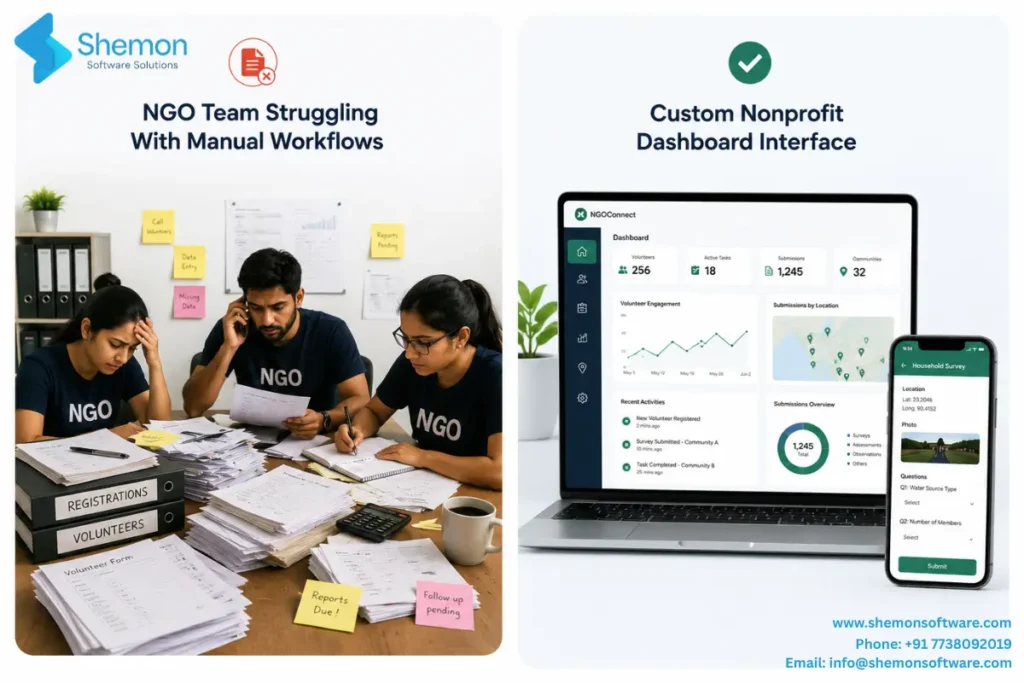
Every non-profit starts with a mission. Feed more families. Educate more children. Protect more lives. But somewhere between the vision and the ground reality sits a stack of spreadsheets, a folder full of donor emails, a volunteer list no one has updated in months, and a grant report that is already three days late.
It is not a motivation problem. It is a systems problem. And it is quietly draining the energy of teams who deserve better tools.
The Sector Is Growing, But the Infrastructure Is Not Keeping Up
The non-profit sector globally manages billions in funding and millions of beneficiary interactions every year. Yet most organisations still operate with tools built for very different use cases. Generic software was never designed for fund tracking across multiple programmes, donor lifecycle management, or field-level impact reporting.
Without the right foundation:
- Reporting becomes a manual nightmare before every audit or funder review
- Donor retention suffers because follow-ups depend on someone remembering to check a spreadsheet
- Programme data stays trapped in the field, never reaching leadership in time to act
- Staff spend hours on tasks that should take minutes, leading to burnout and high turnover
The risk is not just inefficiency. It is losing the trust of donors, funders, and communities who expect transparency and accountability.
So What Exactly Are Custom Software Solutions for Non-Profits?
Software solutions for non-profit organisations are purpose-built digital platforms designed around how these organisations actually work, not how a generic SaaS product assumes they work.
Unlike off-the-shelf tools, custom software is shaped around your specific programmes, your reporting requirements, your donor segments, and your team structure. It can look like:
- A centralised donor portal that tracks giving history, communication logs, and renewal dates
- A volunteer management module with automated scheduling and hour tracking
- A programme monitoring tool that captures real-time field data without needing internet access
- A fund allocation engine that maps every rupee to a specific initiative and generates compliance-ready reports
NGO software solutions of this kind are not built once and forgotten. They grow with the organisation, adding modules and integrations as needs evolve.
From Data Chaos to Clean Operations - Here Is How It Works
The process of implementing the right system is more straightforward than most organisations expect.
- Understanding before building
The first step is always a deep dive into existing workflows. Where is data being captured? Where does it get lost? What does your team spend the most time doing manually? This discovery phase shapes everything that follows.
- Automate the repetitive first Nonprofit workflow automation
Typically begins with the highest-friction tasks: donation acknowledgements, volunteer onboarding, renewal reminders, and fund utilisation summaries. Automating these frees up significant time almost immediately.
- Connect what you already have
Most organisations use a mix of tools. Good custom software does not ask you to throw everything away. It integrates with payment gateways, communication platforms, and accounting tools, creating one connected system instead of five isolated ones.
- Put the right data in front of the right people
A nonprofit reporting dashboard gives leadership a real-time view of programme performance, donor engagement, and fund health. No more chasing reports. No more delayed decisions.
- Scale as you grow
As programmes expand and funding grows, the system expands with you. New modules, new integrations, new users. The foundation is built to hold more weight over time.
What Changes Once the Right System Is in Place
The improvements are not abstract. Organisations that move to purpose-built platforms report very tangible shifts:
- Donor relationships get stronger
A proper nonprofit CRM solution means your team knows exactly who to call, when to call them, and what to say. Lapsed donors get re-engaged. Active donors feel recognised. Retention improves without adding headcount.
- Funds are tracked with full transparency
Cloud solutions for nonprofits allow multi-programme, multi-location fund tracking from a single platform accessible from any device. Every allocation is logged. Every expenditure is traceable. Funders get the accountability they need.
- Impact reporting becomes a strength, not a stress
When field data flows automatically into a central system, generating impact reports for grant renewals or board meetings takes hours, not weeks.
- Teams actually enjoy using the tools
Systems built around how your team works get adopted. Systems that fight your workflow get ignored. The difference is in how the software is designed.
Getting the Most Out of Your New System - A Practical Adoption Guide
Even the best software underperforms if the rollout is handled poorly. Here is how organisations can set themselves up for success:
- Start with one team or one programme as a pilot before rolling out organisation-wide
- Involve staff in the design phase so the system reflects real workflows, not assumed ones
- Run short training sessions with actual use cases, not generic software walkthroughs
- Assign an internal champion who owns the system and drives adoption
- Review usage data in the first 90 days and make adjustments based on real feedback
AI automation for NGOs is also worth introducing gradually. Start with automated donor communication, then move to predictive analytics for donor churn, and eventually to AI-assisted programme evaluation. The technology is ready. The key is a phased, confident adoption.
Why Shemon Is the Right Partner for This Work
Most software vendors sell you a product. Shemon builds you a system. There is a real difference.
Nonprofit digital transformation done right requires understanding how the sector works. Shemon has built platforms for organisations managing donor networks, field programmes, impact reporting, and volunteer coordination. We know the compliance pressures, the budget realities, and the operational complexity that comes with doing meaningful work at scale.
What sets our approach apart:
- We start with discovery, not demos. We understand your organisation before we recommend anything.
- We build in phases, so you see value quickly without waiting for a year-long build to complete.
- We design for real users, which means interfaces your field staff can use on a basic phone, not just your tech-savvy office team.
- We stay involved after launch because good software evolves.
Our solutions are used by organisations running programmes across health, education, livelihood, and social welfare. The common thread is that they needed something that actually fit, and we built it.
Operational Efficiency Is Not a Luxury for Non-Profits - It Is the Mission
Every hour your team spends on manual data entry is an hour not spent on the communities you serve. Every delayed report is a risk to a funder relationship. Every donor who slips away unnoticed is a loss that compounds over the years.
The right technology does not change why you do the work. It changes how much of the work actually gets done.
Non-profits that invest in proper systems raise more, retain better teams, report more confidently, and ultimately serve more people. That is not a technology argument. That is a mission argument.
FAQs
Not necessarily. Many organisations start with a single module, like donor tracking or volunteer management, at a very manageable cost. The return on that investment in staff time saved often justifies it within months.
Most organisations begin seeing operational improvements within the first 60 to 90 days of go-live. The full impact on reporting and donor retention builds over two to three programme cycles.
That is actually where custom software has an edge over generic tools. Because it is built around your team's workflows, the learning curve is much lower. We also provide hands-on training as part of every implementation.
Yes. Multi-programme fund tracking is one of the core use cases we design for. Each funding stream is tracked separately, and reports can be generated per funder, per programme, or at the organisation level.
Tags
Software solutions for non-profit organisations
Nonprofit digital transformation


