
Mobile App Development for Startups: What Founders Actually Need to Know
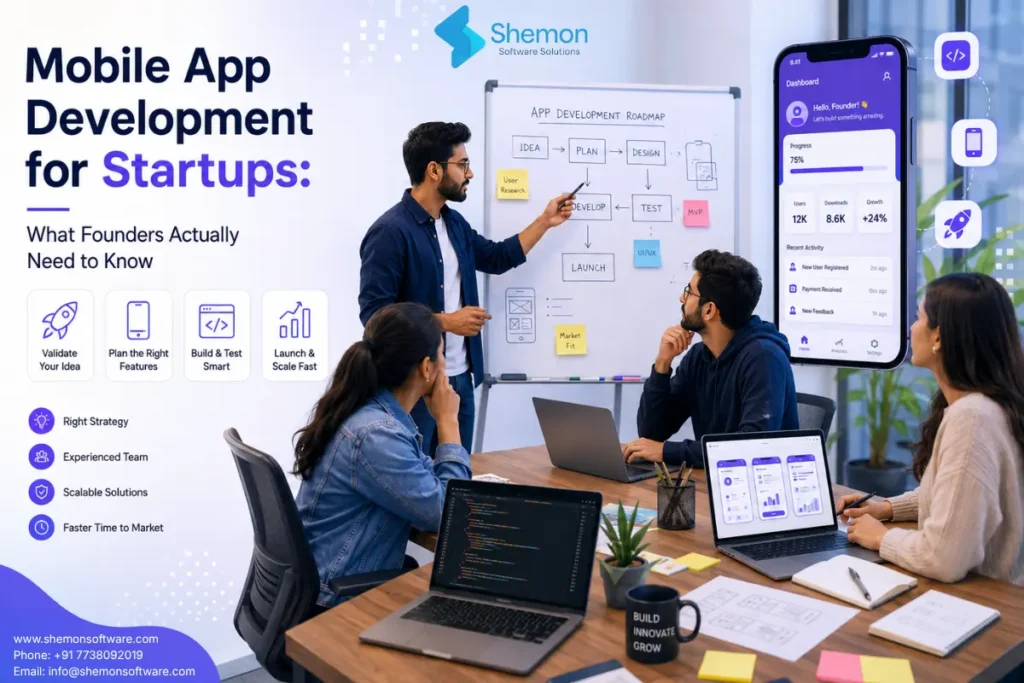
Quick answer: Mobile App Development for Startups is the process of designing, building, and launching a mobile app under startup constraints, limited budget, limited time, and an unproven idea. The right approach starts with a small, testable version (an MVP), not a fully-featured app, and prioritises validating the problem before investing in polish.
Below is a founder-first breakdown of the decisions that actually determine whether a startup app succeeds, written to answer the real questions people ask before they build.
What Is Startup Mobile App Development, Exactly?
Startup Mobile App Development refers to building an app under conditions a typical enterprise project never faces: no existing user base, no guaranteed budget for a second attempt, and a business model that may still be changing. This means the process has to prioritise speed of learning over completeness of features.
In practice, that means:
- Validating the core problem before building anything
- Shipping a working version in weeks or months, not a year
- Treating every early feature as a hypothesis, not a commitment
What Is an MVP, and Why Does It Matter?
An MVP (Minimum Viable Product) is the smallest version of an app that still proves whether users want the core solution. MVP App Development exists specifically to answer one question cheaply: does this problem matter enough for people to use, or pay for a fix?
Before writing code, a useful test is asking:
- Would ten strangers use this in its ugliest form?
- Can the core value be explained in one sentence, with no jargon?
- What’s the one feature that, if removed, kills the whole idea?
If any of those questions stall you, the idea isn’t ready for full development yet.
MVP vs Full Product Development
| MVP | Full Product |
|---|---|
| Core features only | Complete feature set |
| Lower cost | Higher investment |
| Faster launch | Longer timeline |
| Tests market demand | Ready for scaling |
| Easy to change | Expensive to modify |
How Do I Choose a Mobile App Development Company for Startups?
Choose a Mobile App Development Company for Startups based on how they handle change, not just their portfolio. Startups pivot. Requirements shift. A good partner expects this; a weak one locks you into a rigid spec that’s outdated within weeks.
Questions worth asking before signing anything:
- What happens if our requirements change in week three?
- Can you show a startup project you helped pivot mid-build?
- Who owns the code and design files after launch?
What Does Mobile App Development Cost?
The cost of Mobile App Development for Startups depends on the complexity of the application, the number of features, the technology stack, and the level of customisation required. Rather than focusing on a fixed budget, startups should focus on building the smallest version of the product that solves a real user problem.
An MVP (Minimum Viable Product) typically costs less than a fully featured application because it includes only the essential functionality needed to validate the idea and gather user feedback. As the product gains traction, additional features can be developed based on real customer needs instead of assumptions.
Factors that influence the cost of startup app development include:
- Number of features and user roles
- Android, iOS, or cross-platform development
- Custom UI/UX design requirements
- Backend development and database architecture
- Third-party API and payment gateway integrations
- AI-powered features and workflow automation
- Security, testing, and quality assurance
- Ongoing maintenance and future enhancements
Estimated Development Timeline by Project Type
| Project Type | Typical Timeline | Best For |
|---|---|---|
| MVP (Minimum Viable Product) | 6–12 Weeks | Validating a new business idea |
| Medium Complexity App | 3–6 Months | Startups with multiple core features |
| Enterprise Mobile Application | 6+ Months | Businesses requiring advanced integrations, scalability, and custom workflows |
Custom Development vs. No-Code: Which Is Right for a Startup?
Custom Mobile App Development is the right choice when your product depends on a unique workflow, algorithm, or integration that off-the-shelf tools can’t support. No-code tools work well when the app is mostly a container for content, bookings, or simple transactions.
A simple way to decide:
- Choose custom if your competitive advantage lives inside the app’s logic
- Choose no-code if you’re still testing whether the idea has demand at all
Building custom code too early, before demand is proven, is one of the most common ways startups burn cash.
What Should Startup App Development Services Actually Include?
Reliable Startup App Development Services cover the full product lifecycle, not just coding. A complete service typically includes:
At Shemon, our startup app development services include:
- Product discovery and strategy to validate ideas, define user journeys, and prioritise the right features before development begins.
- MVP development focused on launching quickly with the smallest product that delivers real value and gathers market feedback.
- UI/UX design built around user behaviour to create intuitive, engaging experiences.
- Custom web and mobile app development using scalable architectures that grow alongside your business.
- Backend development and API integrations to connect CRMs, payment gateways, communication platforms, third-party services, and internal systems.
- AI-powered features and workflow automation, including intelligent assistants, process automation, and WhatsApp-based business workflows where they create measurable value.
- Quality assurance and testing throughout development to ensure reliability as requirements evolve.
- Cloud deployment, app store submission, and launch support for a smooth go-live experience.
- Post-launch maintenance, enhancements, and scaling to improve performance as your startup grows continuously.
Unlike traditional development firms that simply build what they’re asked, Shemon works closely with founders to understand business workflows, eliminate operational bottlenecks, and build software that supports sustainable growth from MVP to scale.
Why Does App Design Matter So Much for Early-Stage Products?
Good Mobile App Design and development matter because design is really a trust signal; every unclear label or extra tap is a small tax on whether a new user sticks around. A simple test: watch someone use the app for the first time without explaining anything. Every place they hesitate is a design problem, not a user error.
Are There Universal Mobile App Development Solutions?
No – this is one of the most common misconceptions. Mobile App Development Solutions need to match the specific business model, because different app types fail for different reasons:
- Fintech apps live or die on security and compliance
- Social apps live or die on retention loops
- Marketplace apps live or die on solving supply-and-demand at launch
A generic playbook that ignores your specific model is more likely to hurt you than help.
How Does an App Fit into a Startup's Broader Tech Strategy?
An app is rarely standalone; it’s one part of a wider Startup Software Development strategy that includes the backend, website, internal tools, and data infrastructure. Building it in isolation almost always leads to a costly rebuild later, once more users and systems depend on it.
Does Product Development End at Launch?
No – launch is where the real research begins. Serious Product Development for Startups treats the weeks after launch as the most important learning phase, not a finish line. Signs this is working well:
- The roadmap changes based on user behaviour, not internal opinions
- The team can name the biggest drop-off point in the user journey
- Updates happen in small, frequent batches instead of rare, high-stress releases
How Should I Compare Mobile Application Development Services?
When comparing Mobile Application Development Services, price is the wrong primary filter. The better question is reliability after launch: who answers when something breaks in production six months from now? Teams that are cheap and fast up front often cost more later, once real users depend on the product working.
Ready to Build Your Startup App?
Whether you’re validating an idea or preparing to scale, Shemon Software helps startups transform concepts into secure, scalable mobile applications. From MVP development to AI-powered mobile solutions, our team supports every stage of your product journey.
FAQs
The main goal is to validate a real problem quickly and affordably, using the smallest working version of the app, before investing in additional features.
Costs vary by complexity, but an MVP is typically far cheaper than a full-featured app because it includes only the core functionality needed to test demand.
An MVP can often be built in a few months. A fully custom, feature-complete app usually takes longer, depending on integrations and platform requirements.
Most startups start with one platform based on where their target users are most active, then expand to the second platform once demand is proven.
Not necessarily. Many startups successfully partner with development agencies or freelance teams instead of hiring an in-house technical team early on.
Tags
Mobile App Development for Startups
MVP App Development


