
When Growing Businesses Should Invest in Custom Software Solutions
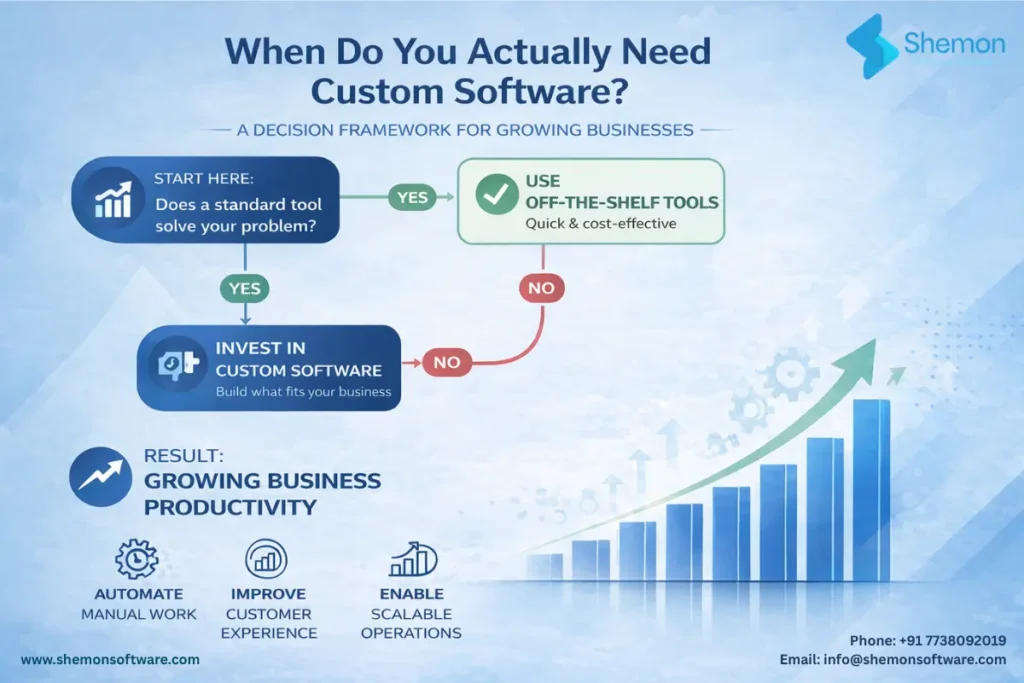
Most businesses start with ready-made software. QuickBooks for accounting, Salesforce for CRM, Shopify for e-commerce, Slack for communication. These tools are fast to set up, affordable, and good enough in the early stages.
But at some point, something shifts. Your team starts maintaining spreadsheets alongside the software to fill the gaps. Integrations break. Workarounds pile up. You’re paying for features you don’t use while missing the ones you desperately need. And every new employee you hire adds another layer of complexity to an already fragile system.
This is the moment most growing businesses face, and the question that follows is always the same: do we keep patching what we have, or do we build something that actually fits?
The Real Cost of Staying with the Wrong Tool
Before exploring when to go custom, it’s worth understanding what staying on the wrong tool actually costs, because most of the damage is invisible.
Signs your current software is quietly costing you:
- Teams maintain parallel spreadsheets because the system doesn’t capture what they need
- Data has to be manually copied between tools that don’t talk to each other
- Reports take hours to compile because nothing is connected
- You’ve hit a feature ceiling and the vendor’s roadmap doesn’t solve your problem
- Per-user subscription costs are growing faster than your revenue
- Compliance, security, or audit requirements can’t be met with your current setup
- New hires need weeks to learn a system stitched together from five different tools
Research shows that around 80% of SaaS features in off-the-shelf tools are never used, yet businesses keep paying for them. Meanwhile, the features that would genuinely save time don’t exist. That gap is exactly what custom software solutions for businesses are built to close.
What Is Custom Software ?
Custom software is built specifically for one business, designed around your workflows, your data, your team structure, and your goals. You own it outright. You control what gets built next. And it grows with you.
What custom software is:
- A platform built around how your business actually operates
- Fully integrated with your existing tools and data sources
- Scalable as your team, volume, and complexity grow
- Built to enforce your specific processes, not generic best practices
- Something your competitors cannot replicate because it’s yours
SaaS vs Custom Software: How to Think About It
The SaaS vs custom software decision isn’t binary. It’s a question of timing, complexity, and strategic priority.
Choose SaaS / off-the-shelf when:
- Your needs are standard and well-served by existing tools
- You need something live within days or weeks
- The process you’re automating is non-core to your business
- You’re in the early validation stage, and the budget is tight
- A vendor tool does 90%+ of what you need without painful workarounds
Choose custom software when:
- Your workflow is unique enough that tailored software development is the only way to get a system that fits without constant compromise
- You’re managing sensitive data with specific compliance requirements
- Integration across multiple systems is creating constant manual work
- You’re scaling, and per-user SaaS costs are becoming unsustainable
- Your competitive advantage depends on how your operations run
- You need role-based controls, audit trails, or approval workflows that generic tools can’t provide
Many businesses start with SaaS and transition to custom as they scale. That’s not a failure; it’s the natural progression of a growing business outgrowing its initial tools.
The Decision Framework: 5 Questions to Ask
Before committing to custom development, run through these five questions honestly:
- Is your workflow genuinely unique?
If your process looks like everyone else’s in your industry, an off-the-shelf tool probably covers it. If your operations have specific rules, exceptions, or structures that no vendor accommodates well, that’s a signal.
- Are workarounds eating your team’s time?
Count the hours spent weekly on manual data transfers, spreadsheet maintenance, and system reconciliation. If the answer is more than 10–15 hours across the team, you’re already paying for a custom build, just in staff time.
- Are you hitting a compliance or security ceiling?
Industries like healthcare, finance, and legal often have data handling requirements that generic SaaS tools can’t fully meet. Enterprise software customisation gives you full control over data architecture, access controls, and audit trails.
- Will this need to scale significantly?
SaaS tools that work for 10 users often become expensive or restrictive at 100. Scalable business software built on custom architecture grows with you without per-seat pricing penalties or vendor-imposed feature limits.
- Is this process core to your competitive advantage?
Non-core functions, payroll, basic email, and standard accounting, are fine on off-the-shelf tools. Core operations that differentiate your business deserve software built around how you specifically do things.
Where Custom Software Has the Most Impact
- Operations & Workflow
Replacing manual, multi-tool workflows with business process automation software that enforces your specific processes, routes approvals automatically, and gives managers real-time visibility.
- ERP & Multi-Department Management
For businesses managing finance, inventory, HR, and operations simultaneously, ERP software development services built around your exact structure eliminate data silos and give leadership a single source of truth.
- Healthcare & Compliance-Heavy Industries
Custom platforms built to HIPAA, GDPR, or industry-specific standards, where off-the-shelf tools either don’t comply or require expensive add-ons that still don’t fully cover requirements.
- SaaS Products
Founders building a product for market need a SaaS application development company that understands not just how to write code, but how to architect for scale, reliability, and user adoption.
- Recruitment & Staffing
Replacing Excel and WhatsApp-led hiring workflows with mandate-first platforms that track candidates, log interactions, and auto-generate client reports, something no generic HR tool does out of the box.
Why Choose Shemon Software Solutions?
We Start with Your Problem, Not the Technology
- Discovery-first, we understand your workflows before recommending anything
- Honest assessment of whether custom is actually right for your stage
- Full audit of existing tools and what can be reused vs replaced
Experience Across Industries That Matter
- Healthcare platforms built to HIPAA and GDPR standards
- E-commerce and retail operations systems
- Therapy and wellness management platforms
- Recruitment and staffing workflow tools
- Real-time dashboards and reporting systems
We Build for Long-Term Fit
- Scalable architecture that grows with your business
- Role-based access, audit trails, and compliance-ready builds
- Integrations with your existing CRM, ERP, and billing tools
- Clean, adoptable interfaces your team will actually use
FAQs
Yes. It can be designed with location wise controls, centralised reporting, role based access from day one.
No. Most solutions reuse existing tools, integrate current databases, and replace only the broken layer.
If integration still requires manual work, break frequently, and don't reflect your workflow then a custom system is the better long-term solution.
No. In many cases some tools stay, some get integrated, and only the gap is built.
You do. That means full control, no vendor lock-in, and freedom to scale and modify.
Conclusion
The right software decision isn’t about what’s cheapest today, it’s about what fits your business best at the stage you’re in and the scale you’re heading toward. Off-the-shelf tools are a smart starting point. But when your workflows outgrow them, when workarounds become a daily tax, when compliance requirements tighten, or when your competitive edge depends on how your operations run, that’s when custom software stops being a cost and starts being a strategic asset.
The businesses that scale efficiently aren’t the ones that found the best SaaS tool. They’re the ones who built the right system at the right time.
At Shemon Software Solutions, we help growing businesses make smart software decisions and build the right solution when the time is right.
Tags
SaaS application development company
ERP software development services


