
Your Website Is a Brochure. That’s Why It Doesn’t Generate Leads.
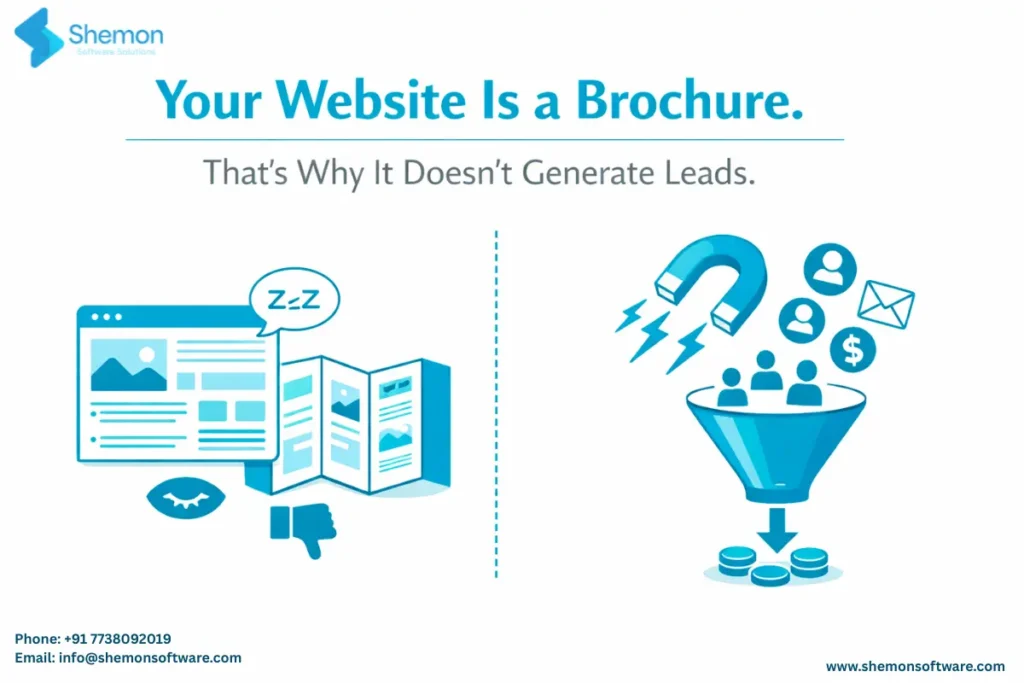
Every day, potential customers visit your website, scroll through it, and leave without doing anything. No call. No form filled. No enquiry sent. And the frustrating part? Your website looks perfectly fine. The real problem is not how it looks; it is what it is built to do. Most business websites are built to impress, not to convert. If your website is not bringing in leads consistently, it is functioning as a digital brochure, not a lead-generation website.
What Is the Difference Between a Brochure Website and a Lead Generation Website?
A brochure website tells people who you are. A lead generation website makes people take action. Most small and mid-sized businesses in India invest in design but ignore the strategy behind it. They fill their website with information about themselves, their history, their team, their awards, without ever guiding the visitor towards a next step.
A conversion focused website, on the other hand, is built around the visitor’s journey. Every page, every button, and every line of text is designed to move someone closer to making a decision. The difference in results between the two can be dramatic, and it has very little to do with how the website looks.
Top Reasons Your Website Is Not Generating Leads
- You Have No Clear Call to Action
This is the most common problem. Visitors land on your website, read through your content, and then leave, because you never told them what to do next. A vague “Contact Us” link buried in the navigation is not enough. Call-to-action optimisation means placing bold, specific, and compelling prompts throughout your website, on the homepage, at the end of every blog post, and especially on your service pages.
Good CTAs are direct. Instead of “Get in Touch,” try “Book a Free 15-Minute Call” or “Get Your Custom Quote Today.” The more specific and low-friction the action, the more likely someone is to take it.
- Your Landing Pages Are Not Built to Convert
Many businesses send paid ad traffic or social media visitors straight to their homepage. This is a costly mistake. A homepage serves many purposes and speaks to many audiences. A landing page optimisation strategy means creating dedicated pages for each specific service, campaign, or audience, pages with no distractions, a single clear message, and one strong call to action.
A well-built landing page removes navigation menus, limits choices, and keeps the visitor focused entirely on one decision. That focused experience is what drives conversions.
- Your Lead Capture Forms Are Too Complicated
If your contact form asks for a name, email, phone number, company name, budget range, and a message, most people will abandon it halfway through. Friction is the enemy of conversions. Lead capture forms should ask for the minimum information needed to start a conversation, nothing more.
Start with just a name and email. You can collect additional details once the relationship has begun. Additionally, placing your form above the fold, meaning visible without scrolling, significantly increases the number of people who actually fill it out.
- Your Website Has No Defined Sales Funnel
Most websites treat every visitor the same way, regardless of where they are in their buying journey. Someone visiting your website for the first time needs different content than someone who has already compared three competitors and is ready to buy. Without a structured sales funnel website approach, you are serving the same message to completely different types of visitors and losing most of them in the process.
A proper funnel guides visitors from awareness to interest to decision, using the right content, offers, and CTAs at each stage. Blog posts and educational content sit at the top. Case studies and testimonials sit in the middle. Free consultations and strong CTAs close the bottom.
The Role of Website Conversion Rate in Your Business Growth
Here is a simple truth most businesses overlook. Doubling your website conversion rate is often far cheaper and faster than doubling your traffic. If your website currently converts 1% of visitors into leads and you improve that to 2%, you have just doubled your leads without spending a single extra rupee on ads or SEO.
Website conversion optimization is therefore one of the highest-return investments a business can make. Small changes, a better headline, a repositioned form, a stronger CTA, can produce significant jumps in lead volume. However, these changes need to be informed by data, not guesswork. Tools like heatmaps, session recordings, and A/B testing show you exactly where visitors drop off and why.
What a True Lead Generation Website Looks Like
Website lead generation is not a single feature, it is a system. Every element of your website plays a role. When built correctly, a lead generation website typically includes a clear value proposition visible within the first three seconds of landing, trust signals such as client logos, testimonials, and certifications placed strategically near CTAs, fast loading speed since even a two-second delay can reduce conversions by up to 20%, and mobile optimisation given that more than 60% of Indian web traffic now comes from mobile devices.
Each of these elements works together to create an experience that builds trust quickly and makes taking action feel easy and natural.
Why Shemon Builds Websites That Actually Convert
Most web design agencies hand you a beautiful website and call it done. Shemon takes a different approach. Shemon builds websites with conversion at the centre, not as an afterthought.
Shemon’s website development process includes:
- Conversion-first design: every page is structured to guide visitors toward a specific action
- Custom landing pages: built for your campaigns, your audience, and your goals
- Lead capture integration: forms, chatbots, and enquiry flows designed to reduce friction and increase submissions
- SEO and speed optimisation: so the right people find your website and stay on it
- Analytics and tracking setup: so you always know what is working and what needs improvement
- Ongoing support: because a high-converting website is never truly “finished”
Whether you are running paid ads, investing in SEO, or relying on word of mouth, Shemon ensures that the traffic reaching your website is not wasted.
FAQs
A call-to-action is a prompt that encourages visitors to take a specific action, such as “Book a Demo,” “Get a Free Quote,” or “Schedule a Consultation.”
Website conversion rate is the percentage of visitors who take a desired action on your website, such as filling out a form or making an inquiry.
Many websites focus only on design and information but lack clear calls to action, optimized landing pages, and simple lead capture forms that encourage visitors to take the next step.
A lead generation website is designed to encourage visitors to take action, such as filling out a form, booking a call, or requesting a quote. Its main goal is to convert website visitors into potential customers.
Landing pages focus on a single message and action, removing distractions and guiding visitors toward completing a specific goal, such as submitting a form or booking a call.
Conclusion
A beautiful website that generates no leads is an expensive missed opportunity. The good news is that most conversion problems are fixable, with the right strategy, structure, and support. If your website is currently acting as a brochure, it is time to transform it into a lead-generation machine. Get in touch with Shemon Software Solutions today and find out how a conversion-focused website can start working as hard as you do.
Tags
Website Development
Lead Generation Website


