
5 MVP Myths That Cost Startups Months and Money
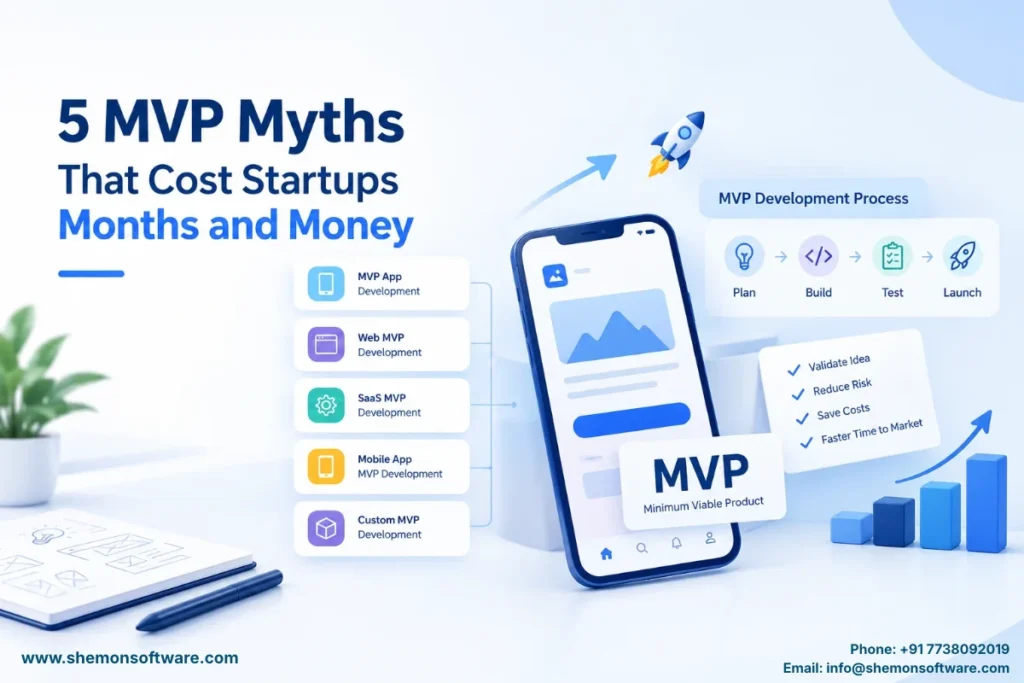
Summary: Many first-time founders make the same MVP mistakes: overbuilding, underplanning, and picking the wrong partner. This guide separates myth from reality and shows what to do instead.
Why the Myths Matter
Building an MVP sounds simple, but many founders end up wasting months on unnecessary features, poor planning, and costly rebuilds. Understanding these common MVP myths can help you launch faster and validate your idea before spending heavily. Working with an experienced MVP development company India can help you sidestep many of them, but only if you know which assumptions to question. Here are the five most common myths we see, and what the evidence actually supports.
Myth 1: “An MVP is a cheap, throwaway version of the product”
Reality: An MVP is a focused product that solves one problem well. It should be built on an architecture that can grow, so you can add features instead of rebuilding from scratch. Treating it as disposable usually leads to a costly second build.
What to do: Keep the scope small but the foundation solid. Define one core workflow and one measurable success metric, such as activation rate or paid pilots.
Myth 2: “More features will make the product more attractive”
Reality: Extra features delay launch and blur what you are trying to learn. Disciplined scoping is the most valuable skill in building MVP for startups. A founder may think they need chat, analytics, reporting, and integrations in the first release. In reality, a simple workflow that solves one problem often provides enough validation.
What to do: Sort every feature into three groups:
- Must have: the product cannot solve the core problem without it.
- Should have: it improves the experience but doesn’t block validation.
- Later: everything else.
If a feature does not teach you something important in the first release, it can wait.
Myth 3: “Investors only care about the idea”
Reality: At later stages, investors look for evidence. Founders planning MVP development for Series A startup funding should expect questions about retention, conversion, customer validation, and technical credibility.
What to do: Build analytics into the MVP from day one. Collect usage data, secure paying pilots, and document your architecture and security basics. Showing how much you achieved with limited capital also builds confidence.
Myth 4: “Building in India means compromising on quality”
Reality: The quality of an MVP depends more on the team, process, and product thinking than the location itself. India has a deep pool of engineers experienced in SaaS, healthcare, fintech, and operations-heavy platforms. Agile delivery, time-zone overlap with Europe, the Middle East, and Asia-Pacific, and lower costs that extend your runway make it a strong choice for early-stage products.
Founders exploring MVP app development India can reach the market faster without sacrificing quality, provided they choose the right partner. Providers of custom MVP development services India also tend to understand lean budgets and the need to show investors steady progress.
Myth 5: “Launch is the finish line”
Reality: Launch is when learning begins. Real user behaviour will challenge your assumptions, and the teams that grow fastest iterate quickly on feedback.
What to do: Plan a post-launch phase that covers monitoring, bug fixes, and a prioritised backlog for version two.
Five Questions to Ask Any Development Partner
- Can they show relevant case studies at a similar stage and complexity?
- Do they start with discovery or a quote? Strong partners clarify the problem first.
- Who owns the code and IP? Get the answer in writing.
- How transparent is the process? Look for sprint demos and clear milestones.
- What happens after launch? Support and iteration should be defined upfront.
A reliable MVP software development company India will answer all five clearly, and a dedicated MVP development service should be able to explain how it validates scope before development begins.
A Typical 16-Week Path
- Weeks 1-2: Discovery, user research, success metrics.
- Weeks 3-4: Design, architecture, prioritised backlog.
- Weeks 5-12: Iterative development with demos every two weeks.
- Weeks 13-14: Testing, security checks, limited pilot.
- Weeks 15-16: Review data, refine, plan version two.
Why Founders Choose Shemon Software Solutions
Based in Mumbai, Shemon Software partners with founders and product teams from idea to scale. Its approach addresses the myths above directly:
- Startup-first engineering. The team helps startups design, build, validate, and scale MVPs for Seed and Series A funding.
- Speed with structure. Products move from MVP to V1 in three to four months through short, iterative cycles.
- AI-first architecture. AI copilots, workflow automation, and intelligent features can be built in from the start.
- Delivery in regulated settings. For Butterfly Learnings, Shemon replaced pen-and-paper processes with a web and mobile therapy platform meeting HIPAA and GDPR requirements.
- Modern stack: JavaScript, React, Django, .NET, PostgreSQL, and Flutter.
- Support after launch. Architecture is designed to scale to 10K+ users, with ongoing support of three to twelve months depending on the package.
Its free 15-minute discovery call is a low-commitment way to map your product and receive a tailored proposal.
FAQs
Cost depends on scope, features, and platforms. A tightly focused first version costs far less than a full product, so the best way to control budget is to limit scope to one core workflow.
Typically three to four months for a first live version. Shemon Software takes products from MVP to V1 in that window.
No. A development partner can handle product thinking, design, and engineering, so you can focus on customers and funding.
Yes, if it comes with data. Usage, retention, and paying pilots matter more to investors than the number of features.
You review user data, fix friction points, and plan version two. Shemon includes three to twelve months of ongoing support, depending on the package.
Conclusion
An MVP is not about building less. It is about learning faster, validating demand earlier, and reducing risk. Founders who focus on solving one problem well can reach the market sooner and make better product decisions based on real customer feedback. Whichever MVP development company you choose, prioritise clear scoping, transparent communication, and a team that cares about your business outcomes as much as your code.
Ready to build your MVP the right way? Schedule a discovery call with Shemon Software to discuss your idea.
Tags
MVP development company India
MVP app development India


